
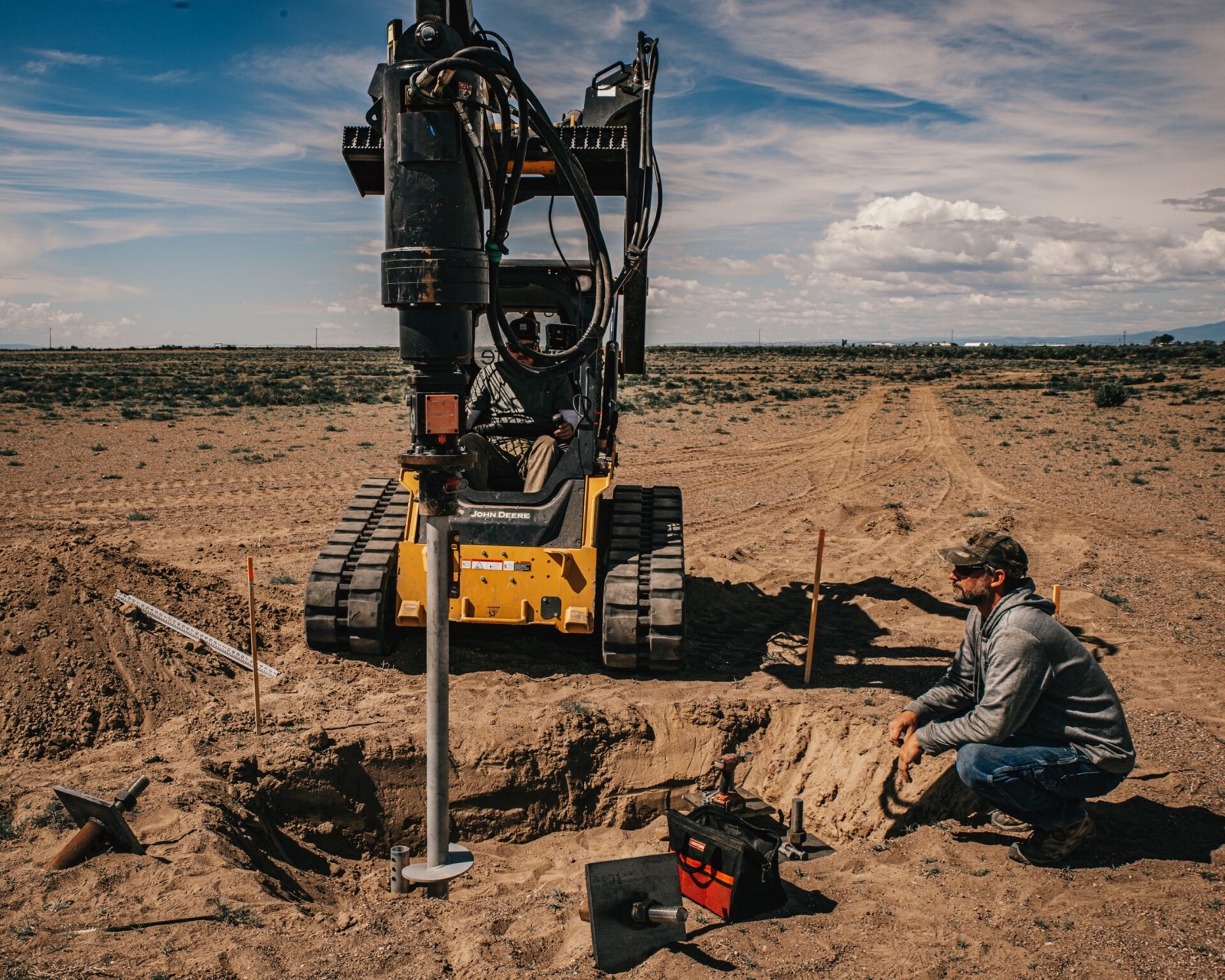
Helical Piers in Denver, CO
Site Safe Helical Piers installs helical piers and piles for new construction in Denver: new homes, additions, ADUs, decks, solar ground mounts and commercial buildings. We install each pile to the depth and torque on your engineer’s drawings and hand over the installation log.
What we install in Denver
We install the helical piles that new foundations are built on, and we work on new construction only. Your concrete contractor forms the caps, grade beams or footings on top of the piles; we don’t pour concrete.
- New homes. The house sits on the piles, and the piles bear in deeper, steadier ground than the clay near the surface.
- Home additions. Compact rigs fit the side yards, alleys and backyards where additions go.
- ADUs. On swelling clay or a tight alley lot, piles and a grade beam take the drill rig out of the backyard.
- Decks. Piles go below the 36-inch frost line with minimal digging, and framing can start the same day.
- Garages. The piles carry a concrete grade beam that supports the walls.
- Solar ground mounts. Each pile holds the racking down against wind uplift as well as up under snow.
- Commercial buildings, pipeline supports, docks and bridges.
See residential helical piers and commercial helical piers for each project type.

Why Denver soil calls for deep foundations
Much of Denver sits on expansive clay, and the city’s frost line is 36 inches. A shallow footing can sit in soil that swells, shrinks or freezes. A helical pile carries the load past that soil to firmer ground, at the depth your engineer sets.
Expansive clay
The Colorado Geological Survey says expansive soil can grow 10 percent or more in volume when wet and push with pressures of 20,000 psf or more. The layer that swells and shrinks with the seasons, which soils reports call the active zone, is often deeper than the frost line. A footing at 36 inches can still sit in clay that heaves every spring, so the foundation has to clear whichever is deeper.
Pierre Shale and bentonite
Pierre Shale underlies large parts of the Front Range and contains thin beds of bentonite. In a USGS-involved study of a southwest Denver metro subdivision, bentonite beds swelled 39 to 43 percent in lab tests, while the claystone beside them swelled 2 to 8 percent. Our Pierre Shale guide covers what that means for design.
Frost depth and the soils report
Denver’s residential code sets a 36-inch frost line in Table R301.2 and requires a soils test where expansive soil is likely (R401.4). Most new homes in the metro end up with a soils report, and the engineer sets pile depth from it. See the frost line in Colorado, the Denver building code for foundations and why helical piers suit Colorado soil.

How a Denver installation works
A pile foundation runs in a fixed order: soils report, pile design, permit, installation, inspection, then concrete. Our part is the installation and the log.
- Soils report. A geotechnical engineer tests the lot and recommends a foundation type.
- Pile design. Your structural engineer sets the pile layout, minimum depth and minimum installation torque for each pile.
- Permit. The stamped pile layout, the soils report and the manufacturer’s ICC-ES evaluation report go to plan review.
- Installation. We turn each pile in with a hydraulic torque motor until it meets both the depth and the torque on the drawings, and log both for every pile.
- Inspection. Denver applies special inspection to residential and commercial jobs, so the inspector records depth and torque as the piles go in.
- Concrete. Your concrete contractor sets the caps and pours the grade beam or footings.
More on our helical pile installation process.

Areas we serve
We install helical piles across Denver and in these nearby cities.
Denver helical pier questions
Do you do foundation repair in Denver?
No. Site Safe Helical Piers installs helical piles for new construction only: new homes, additions, ADUs, decks, solar ground mounts and commercial buildings. We don’t underpin or level existing foundations, and we don’t pour concrete. Your concrete contractor builds the caps, grade beams or footings on the piles we install.
How deep do helical piers go in Denver?
Deep enough to meet the engineer’s minimum depth and minimum installation torque at the same time, so there is no fixed number. Bearing has to be below Denver’s 36-inch frost line at a minimum. On swelling clay the helix plates go below the active zone, which the Chance design manual puts at about 10 feet on a typical site. See how deep helical piers go.
Do you need a permit for helical piles in Denver?
Yes. Denver’s residential code has no prescriptive helical pile rules, so the piles are an engineered design: a stamped pile layout, the soils report and the manufacturer’s ICC-ES evaluation report go to plan review, with minimum depth and torque on the drawings. Denver’s Section 141.1 also applies special inspection to residential jobs, so an inspector records depth and torque during installation. Our guide to the Denver building code for foundations covers the details.
Does Denver require a soils report for a new house?
Where expansive, compressible or shifting soil is likely, yes, under section R401.4 of the Denver Residential Code. Much of the metro sits on expansive clay, so most new homes end up with one. Read why soil testing comes before a new home.
Can helical piles be installed in a Denver winter?
Yes. A helical pile’s bearing plates sit well below the frozen layer, and piles can be installed through frozen ground, although pre-drilling may be needed. Concrete footings can’t bear on frozen soil, so a concrete crew has to keep the bottom of the excavation from freezing. See pouring concrete in winter.
Get your free estimate
You’ll see why we’ve earned the reputation as being one of the top new construction foundation companies in Colorado & why we offer a rock solid guarantee to back it up.