
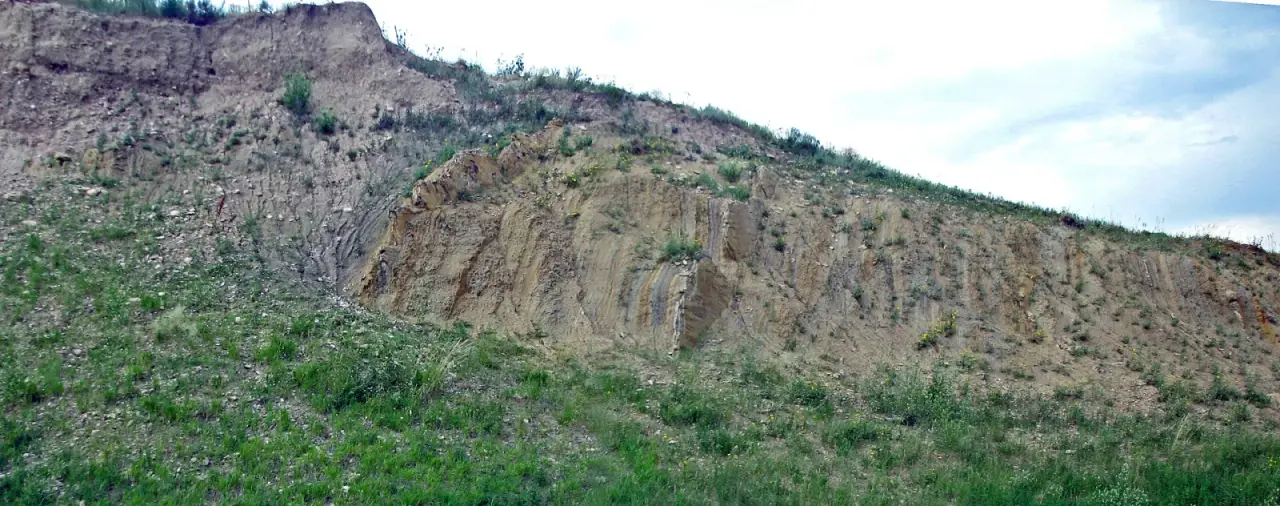
Pierre Shale is a thick, dark-gray marine shale and claystone laid down in a Late Cretaceous sea, and it underlies large parts of the Colorado Front Range. For builders it matters because of what’s inside it: thin beds of bentonite, altered volcanic ash, that swell far more than the claystone around them. Where those layers lie flat and deep, they’re a manageable expansive-soil problem. Where they’ve been tilted on edge along the foothills and come close to the surface, they can produce “heaving bedrock” that cracks foundations and buckles streets. If your lot sits on Pierre Shale, the soils report and the foundation design have to account for which situation you’re in.
What Pierre Shale is
The formation spans the Great Plains from Canada to New Mexico, east of the Rockies, and most of it was deposited in the Campanian age of the Late Cretaceous. It’s mostly dark-gray shale with gypsum seams and iron-oxide concretions, and it includes bentonitic members. At its type locality it’s about 3,138 feet thick (Wikipedia). Around Garden of the Gods the Friends of the Garden of the Gods put its age at about 73 to 70 million years and its thickness at roughly 5,000 feet, made of sea mud and clay, and note that most of Colorado Springs sits on it (Friends of the Garden of the Gods).
Geologists know it for its fossils: ammonites, mosasaurs, plesiosaurs. Builders know it for its clay.
Why the bentonite beds are the problem
The worst-documented case is a southwest Denver metro subdivision built on steeply dipping Pierre Shale in 1986. Shortly after construction, part of it began moving enough to fail house foundations and warp pavements. A USGS-involved study traced the damage to bentonite beds that ran parallel to the strike of the tilted strata, matching the lines of heaved pavement. In lab swell tests, samples of two bentonite beds swelled 39 to 43 percent, while samples of the ordinary silty claystone next to them swelled 2 to 8 percent. The bentonite bed tied to the worst damage was about 62 percent smectite by weight (Gill and others, 1996).
That contrast is the whole story. A uniform expansive clay heaves more or less evenly. A stack of tilted layers where one thin band swells five to twenty times more than its neighbors heaves in ridges, and a foundation that crosses one gets lifted on a line.
Heaving bedrock: when the layers stand on edge
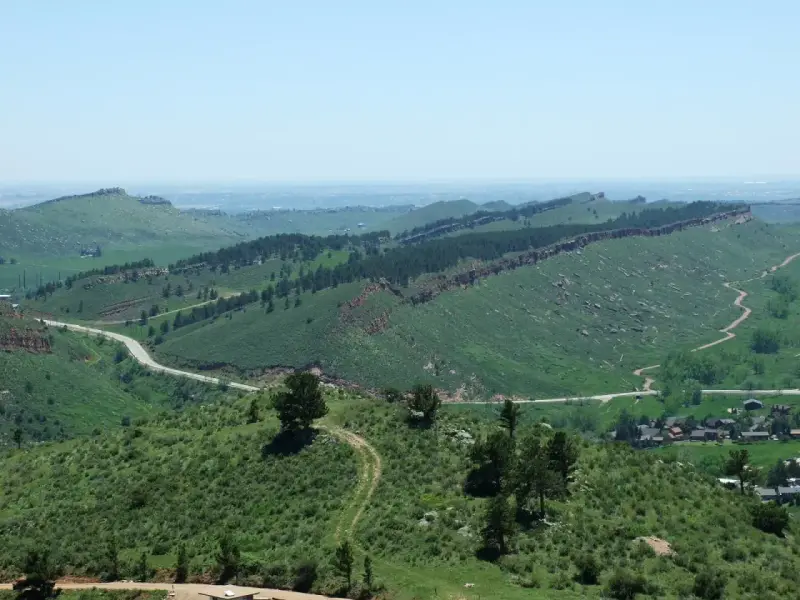
Near the mountain front, the sedimentary rocks were bent up as the Rockies rose, so the layers dip steeply. The USGS surficial map of the Denver area notes that expansive claystone can swell along certain beds as it takes on water after overburden is removed during excavation, “especially where the dip of bedding exceeds 30°”, with recent damage concentrated in Douglas, Jefferson and Boulder counties and the cost of that damage running to tens of millions of dollars (USGS MF-2347).
Jefferson County regulates this directly through its Designated Dipping Bedrock Area. Its guide says ridges of heaving bedrock as large as two feet high, several tens of feet wide and several hundreds of feet long have been mapped; that damage typically shows within ten years after development; and that the bedrock in the area dips 30 to 90 degrees (Jeffco DDBA Guide). Pierre Shale is one of the formations the district covers.
A later case study of another subdivision near Denver, also on steeply dipping Benton Shale, Niobrara and Pierre Shale, found linear heave features with up to about 1 foot (0.3 m) of differential movement. The worst ones lined up with silty claystone containing thin, very highly plastic bentonite layers. Those features faded as depth to bedrock increased, becoming small to negligible where 10 feet (3 m) or more of soil or fill covered the bedrock (Noe, 2005).
What that means for foundation design
The honest point first: deep foundations are not automatically the answer in steeply dipping Pierre Shale. The Colorado Geological Survey’s heaving-bedrock study found that treating the bedrock as a uniform expansive soil failed, and that conventional drill-hole exploration and drilled pier foundations proved inappropriate for recognizing and mitigating the hazard because the bedrock is so variable from layer to layer (CGS SP-45). A pier that ends in, or passes through, a swelling bentonite band can be pushed up by it.
What has worked, and what the regulations reflect:
- Overburden. Jefferson County’s district requires at least ten feet of overburden soil or structural fill between the bottom of the foundation and the top of bedrock for inhabited structures, or detailed engineering showing another method works. If deep pier foundations are proposed, the county may send the plans to its Engineering Advisory Board (Jeffco DDBA Guide). That matches the USGS finding that damage dropped off with 10 feet or more of cover.
- Mapping the layers. The DDBA rules call for a geologic report with a top-of-bedrock contour map and may require trenching to expose the bedrock, rather than relying on a few borings.
- Drainage. Subsurface groundwater collection systems with positive drainage are part of the district’s requirements, since water is what triggers the swell.
- Foundation elements designed for uplift. Where deep elements are used, they have to be designed for the uplift the swelling material can exert along the shaft, with bearing in material that won’t heave.
Flatter-lying Pierre Shale farther from the foothills behaves more like ordinary expansive bedrock. There, foundations that bear below the active zone, with structural floors and void spaces under beams, are standard practice.
Where helical piles fit
Helical piles are one of the deep-foundation options an engineer may consider on Pierre Shale, and they bring two useful traits. The Hubbell/Chance design manual points out that the swell force on a pile shaft is proportional to the shaft’s surface area in contact with swelling soil, so a small steel shaft picks up much less uplift than a large drilled or driven pile (CHANCE Technical Design Manual). And every pile’s depth and torque is logged, which gives the engineer a running picture of what the ground is doing across the site.
They aren’t a shortcut around the geology. In a dipping-bedrock district, the foundation type is the engineer’s call after the geologic mapping, and the county may review it. Piles also can’t be screwed into hard, intact rock, so the bearing layer has to be something a helix can reach and hold.
Checklist before you buy or design on Pierre Shale
- Check whether the lot is inside a mapped dipping-bedrock area (Jefferson County publishes its DDBA map; ask other counties what they use).
- Read the soils report for bedrock type, depth, and dip, and for any bentonite seams on the logs.
- Ask whether the geologist trenched or only drilled. In steeply dipping bedrock, trenches show bed-by-bed variation that borings miss.
- Ask how much overburden or fill will sit between the foundation and bedrock.
- Look at the neighborhood. Linear cracks or humps in streets and curbs running the same direction are a heaving-bedrock signature; the Colorado Geological Survey describes the resulting “roller-coaster” road pattern.
- Plan drainage and landscaping with the foundation, not after it.
Building on Front Range bedrock?
Site Safe Helical Piers installs helical piles for new homes, additions and commercial buildings across Denver and the Colorado Front Range, working from your geotechnical engineer’s design. If your lot sits on Pierre Shale or other expansive bedrock, send us the soils report and we’ll talk through whether piles fit. Call 970-673-5615 or get in touch. For background, see why helical piers suit Colorado soil, foundation options for expansive soil, our Lakewood service page, and our services.
_(30399742426).jpg)