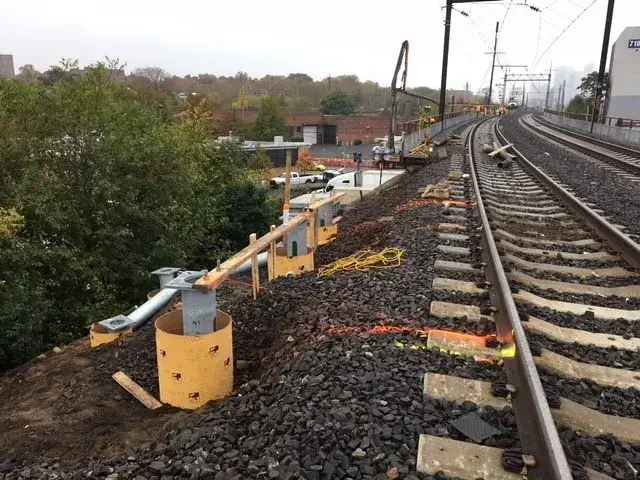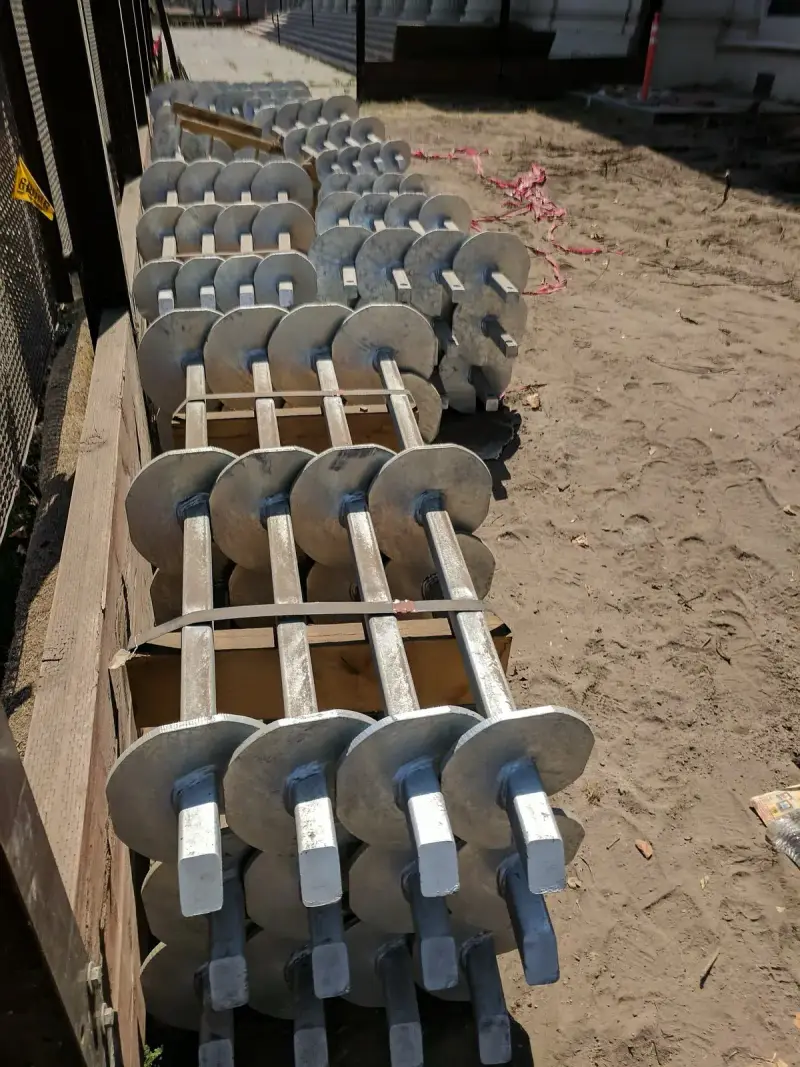
Helical piles are steel foundation piles shaped like big screws. Each one is a steel shaft with one or more round, spiral plates (helices) near the tip. A machine turns it into the ground, and the plates pull it down through the soil. It keeps going until it reaches firm soil at the depth and torque an engineer set. A building’s load then goes down the shaft to the plates and out into that firm soil. On the Colorado Front Range, helical piles are a common way to put new homes, additions and decks below the frost line and below swelling clay.
What is a helical pile, part by part?
A helical pile has three main pieces:
- The lead section is the bottom length of shaft with the helix plates on it.
- Extensions are plain lengths of shaft bolted on as the pile goes deeper.
- The cap or bracket at the top ties the pile into the concrete or steel above.
The shafts are square bar or round pipe. ICC-ES acceptance criteria AC358, which manufacturers’ products are evaluated against, sets the geometry for its standard torque rules: square shafts from 1.5 to 3 inches, round shafts from 2.125 to 4.5 inches across, helix plates 8 to 14 inches in diameter and 3/8 to 1/2 inch thick, and a 3 inch pitch on every plate. On a multi-helix pile the smallest plate goes at the bottom and the larger ones sit above it, spaced 2.4 to 3.6 helix diameters apart.
Helical pile, helical pier, helical anchor: what’s the difference?
People mostly use the names interchangeably, and for a homeowner the product is the same. Wikipedia lists screw piles, screw piers, helical piles, helical piers and helical anchors as names for the same steel screw-in system, and draws one useful line: an anchor is a pile used only in tension, to resist pulling forces such as uplift on a tower or a retaining wall tieback. A pile or pier carries the building’s weight down into the ground.
In practice, “pier” tends to show up on residential jobs and “pile” in engineering documents and the building code, which uses “helical pile” throughout.
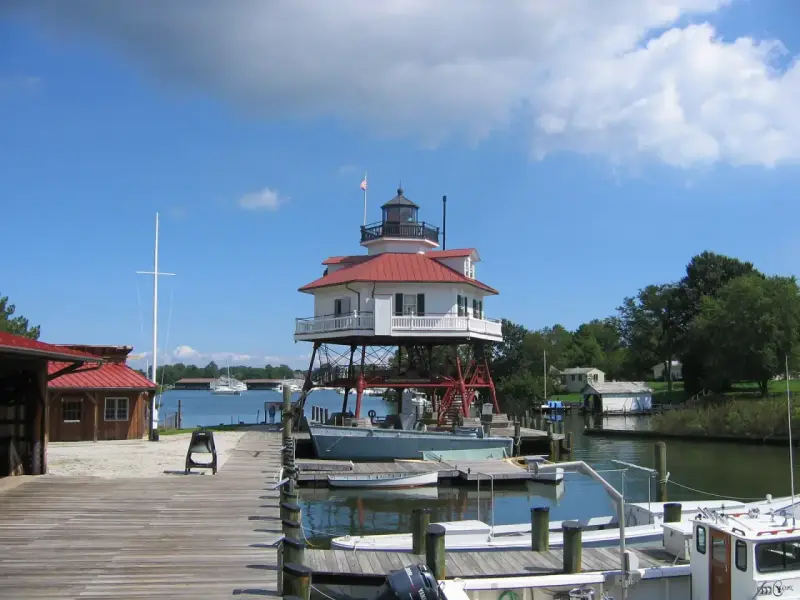
The concept is old. Iron screw piles held up harbor piers and lighthouses in the 1800s, and Wikipedia counts more than 100 screw-pile lighthouses built on the US east coast between the 1850s and 1890s. The steel versions used under buildings today are a recognized deep foundation in the International Building Code.
How do helical piles work?
Load travels down the shaft to the helix plates, and each plate bears on the soil under it the way a small footing would. Engineers model that in two ways, according to Hubbell’s CHANCE engineering group:
- Individual bearing treats each helix as its own end-bearing plate and adds up their capacities.
- Cylindrical shear treats the plates and the soil between them as one block. Capacity is the end plate plus the shear strength of the soil along the cylinder the plates outline.
Whichever method gives the lower number governs. Closely spaced plates behave as a cylinder, and widely spaced plates act individually. Hubbell says field data put the switch at about three helix diameters, which is why its engineers space helices three diameters apart.
The building code adds a safety margin. Under IBC 1810.3.3.1.9, a helical pile’s allowable load is half of its ultimate capacity, and the ultimate capacity is the lowest of six checks:
| Check | What limits the pile |
|---|---|
| Base capacity plus shaft friction | Helix plate area times the bearing capacity of the soil, plus skin friction on the shaft above the top plate |
| Torque correlation | Capacity from well-documented correlations with installation torque |
| Load tests | Results of load tests, where the code requires them |
| Shaft | Axial capacity of the steel shaft |
| Couplings | Axial capacity of the bolted joints between sections |
| Helix plates | Combined axial capacity of the plates themselves |
Strong soil doesn’t help if a coupling is undersized, because the lowest of the six sets the pile’s capacity.
Why the installation torque tells you capacity
The harder the soil, the harder the drive head has to work to turn the helices through it. That resistance is measured as torque, and the final torque at the end of installation reflects the strength of the soil the plates finished in.
AC358 turns torque into capacity with a ratio, Kt. Ultimate capacity equals Kt times final torque, and the default values are:
| Shaft | Default Kt |
|---|---|
| 1.5 in or 1.75 in square | 10 per ft |
| 2.875 in round | 9 per ft |
| 3.0 in round | 8 per ft |
| 3.5 in round | 7 per ft |
A worked example: a 3.0 inch round shaft that finishes at 5,000 ft-lb has an ultimate capacity of 8 × 5,000 = 40,000 lb. The allowable load is half, 20,000 lb, as long as the shaft, couplings and plates aren’t the lower limit. Manufacturers can prove other Kt values with load tests, and the product’s evaluation report lists them.
The same torque also sets a ceiling. IBC 1810.4.11 says installers can’t exceed the manufacturer’s rated maximum installation torque, because over-torquing can damage the shaft you’re relying on. Every pile on the job gets its own torque reading, so you end up with a written record of each pile’s capacity. Our page on how helical pier installation works walks through the job itself.
What is a helical pier foundation?
It’s the whole system: the piles in the ground plus the reinforced concrete that ties them to the building. Under IBC 1810.3.11, pile caps are reinforced concrete, grade beams count as pile caps, the top of each pile is embedded at least 3 inches into the cap, and the cap extends at least 4 inches past the pile’s edges. The code also says the soil right under a pile cap isn’t counted on to carry vertical load, so the piles carry it all.
On a new house, that usually means piles at the corners and along the walls under a concrete grade beam. On a deck, it means one pile under each post with a steel cap.
Why helical piles are common on the Front Range
Two local conditions favor them. Denver’s design frost depth is 36 inches (Table R301.2 of the residential code), and bearing has to be below it. And much of the Front Range sits on expansive clay. The Colorado Geological Survey says this soil can swell up to 20 percent by volume when it gets wet and push with pressures of 20,000 pounds per square foot or more.
A helical pile carries the structure past both, down to soil that stays put. Read more about foundation options for expansive soil.
Talk to us about helical piles for your build
Site Safe Helical Piers installs helical piles for new homes, additions, decks, solar and commercial projects in Denver and along the Colorado Front Range. We set each pile to your engineer’s depth and torque and hand over the installation log. See our services, contact us or call 970-673-5615.