Micropiles and helical piles are both small-diameter deep foundations, and both can carry a building through bad soil to something better. The difference is how they get their capacity. A micropile is a drilled hole with steel in it, filled with grout that bonds to the soil or rock around it. A helical pile is a steel shaft with helix plates screwed into the ground, and the installation torque is one of the ways its capacity is checked.
For most new houses, additions and light commercial buildings on soil, helical piles are faster and simpler. Micropiles earn their higher cost where the piles have to go into rock, through cobbles and boulders, or carry loads a helix can’t.
What is a micropile?
Caltrans describes a micropile as a relatively small diameter grouted pile with internal reinforcement, typically less than 12 inches across. The crew drills a borehole, usually with temporary casing, sets the steel (a single bar, a group of bars, a steel casing, or a mix), and grouts the hole. Micropiles are usually designed in small groups that share the load, and they can be built to resist compression, tension and lateral force.
IBC 1810.3.5.2.3 limits micropiles to a nominal diameter of 12 inches, and 1810.3.10.1 says they develop their capacity through a bond zone in soil, bedrock or both, must be grouted, and must have a steel pipe, tube or reinforcement at every section along the length.
How the grout goes in matters a lot, because the bond between grout and ground is where most of the capacity comes from. The FHWA and AASHTO grouting types, as summarized in the Caltrans manual, run from A to E:
| Type | How it’s grouted |
|---|---|
| A | Grout placed under gravity head only; generally used in rock |
| B | Neat cement grout injected under pressure (typically 6 to 21 ksf) while the casing or auger is pulled |
| C | Gravity grouting, then a second injection under pressure 15 to 25 minutes later through a sleeved pipe |
| D | Like C, but the first grout hardens before the second injection under higher pressure (typically 42 to 170 ksf) |
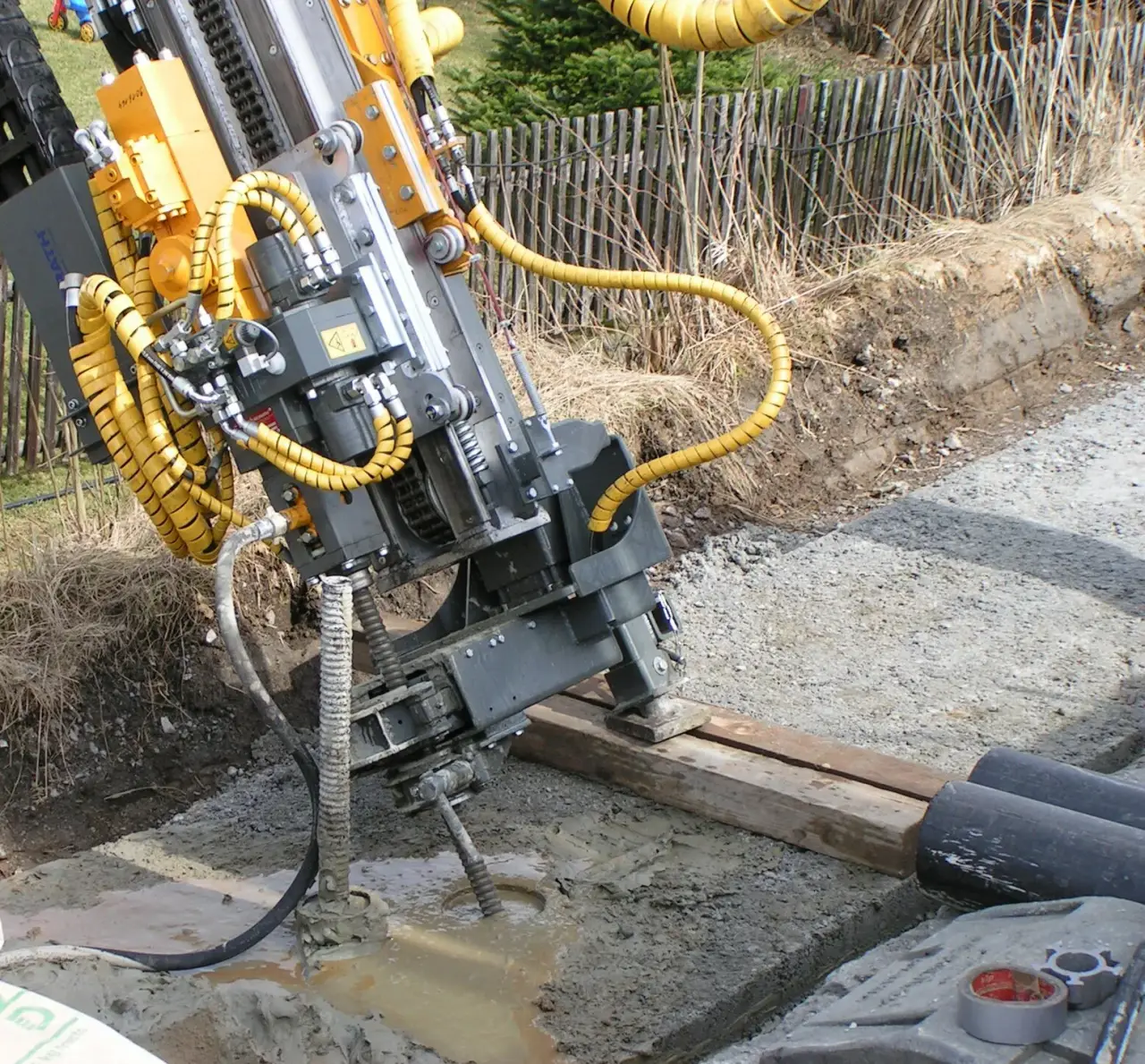
| E | Drilled with grout pumped through a continuous-thread hollow steel bar; the grout flushes the cuttings and stays in place |
In a Type E micropile like the one in the photo, the threaded bar is both the drill rod and the reinforcement.
What is a helical pile?
A helical pile is a steel shaft, round or square, with one or more helix-shaped bearing plates near the tip. A hydraulic drive head turns it into the ground like a screw, so nothing is drilled out and nothing is grouted. Extensions are bolted on until the pile reaches the depth and torque the engineer specified.
IBC 1810.4.11 sets the installation rule: helical piles go to the embedment depth and torsional resistance criteria set by a registered design professional, and the installer can’t exceed the manufacturer’s rated maximum torque. ICC-ES AC358 is the acceptance criteria used to evaluate helical pile systems for axial compression, axial tension and lateral load, so ask for the product’s evaluation report.
Micropiles vs helical piles, side by side
| Micropiles | Helical piles | |
|---|---|---|
| How it goes in | Drilled, steel placed, grouted | Screwed in by a hydraulic drive head |
| Where capacity comes from | Grout-to-ground bond along the bond zone; sometimes end bearing in rock | Bearing on the helix plates, plus some shaft friction |
| How capacity is checked in the field | Load tests and the drilling and grouting record | Installation torque, depth and load tests where required |
| Ground it suits | Rock, cobbles, boulders, mixed fill, old foundations in the way | Clay, silt, sand and gravel that a helix can advance through |
| What stops it | Little; the drill goes through most obstructions | Dense cobbles, boulders and hard rock before design depth |
| Cure time | Grout has to harden before load, and before drilling next to it | None; no grout to cure |
| Spoils and water | Drill cuttings and grout return to manage | No spoils |
| Inspection records (IBC Chapter 17) | Drilling records, element dimensions, embedment, grout volumes (Table 1705.8 for cast-in-place elements) | Equipment, pile dimensions, tip elevations, final depth and final torque (1705.9) |
Micropiles cost more. Wikipedia’s piling article puts it down to their relatively high cost and the equipment they need, and says that’s why they tend to be used where access is restricted or the ground is very difficult (cobbles and boulders, construction debris, karst), and only occasionally as the foundation for new construction.
How each one is designed under the IBC
Micropiles
Section 1810.3.10 covers micropile design. Reinforcing bars must be ASTM A615 Grade 60 or 75, or ASTM A722 Grade 150. A steel pipe or tube needs a wall at least 3/16 inch thick, a yield strength of at least 45,000 psi and at least 15 percent elongation.
The steel has to carry a share of the load. Where the micropile is grouted inside a casing, in a hole drilled into bedrock or in a hole drilled with grout, the steel must be designed for at least 40 percent of the design compression load. Where it’s grouted in an open hole in soil with no casing and no way to check the hole diameter during grouting, the steel has to carry the whole compression load.
Seismic rules add casing. For Seismic Design Category C, a permanent steel casing runs from the top of the micropile down to the point of zero curvature. In Categories D through F, micropiles are treated as an alternative system that needs the building official’s approval.
Installation is covered in 1810.4.10. Holes are drilled by rotary or percussive methods, grout is pumped through a tremie from the bottom until good grout comes out the top, and the next micropile can’t be drilled near one that’s been grouted until that grout has hardened. For end bearing micropiles, the crew has to verify the bearing surface is clean before grouting.
Helical piles
IBC 1810.3.3.1.9 sets the allowable load of a helical pile from the lowest of several checks: the helix plates’ area times the bearing capacity of the soil or rock plus shaft friction above the top plate, a documented correlation with installation torque, load tests where required, and the strength of the shaft, the couplings and the plates themselves. The torque record is part of that check, so every pile gets one.
Section 1705.9 requires continuous special inspection while helical piles go in, with the installation equipment, pile dimensions, tip elevations, final depth and final installation torque recorded for each pile.
Front Range ground: what pushes a job one way or the other
The soils report decides this, and IBC 1803.5.5 asks it to recommend the deep foundation type, installed capacities, spacing, installation and inspection procedures, and the bearing stratum. Read our notes on why soil testing matters before building a new home and geotechnical testing for commercial construction before you get the report back.
Expansive clay is the common case. The Colorado Geological Survey says swelling clays underlie many populated areas of the state, can expand 10 percent or more as they get wet, and can push on foundations with 20,000 psf or more. IBC 1808.6.1 requires foundations that pass through expansive soil to be designed against uplift and to resist the forces from the soil’s volume change or be isolated from them. Both pile types can do that when they’re anchored below the active zone. Helical piles usually get there quicker on clay, because the helix advances through it and there’s no hole to keep open.
Claystone and sandstone bedrock are where the choice gets closer. A helical pile can bear on weathered rock if the helix can get into it, but hard, unweathered rock stops it. A micropile can be drilled into the rock and bonded there.
Cobbles and boulders can stop a helix short of its design depth. That’s the ground where micropiles are most often used, because a drill can usually work through it.
Tight sites cut both ways. Micropiles are often picked for restricted access. A helical pile crew doesn’t need a grout plant, water supply or a place to put cuttings, which helps on a backyard addition or a narrow lot.
Schedule matters on new work. With helical piles there’s no grout cure, so once the piles are installed and accepted, the concrete crew can form the caps and grade beams. With micropiles the grout has to harden first.
Questions to settle before you choose
- What does the soils report recommend, and does it mention rock, cobbles or refusal depths?
- What loads do the piles carry, including uplift from swelling clay and wind?
- Can a helix reach the bearing layer, or does the boring log show material it can’t get through?
- What access, water and laydown space does each crew need?
- Who does the special inspection, and what goes in the installation record?
- How does the schedule change if the piles need grout cure time?
Planning a deep foundation for a new build?
Site Safe Helical Piers installs residential and commercial helical piles for new construction around Denver and the Colorado Front Range, and can help line up foundation design and geotech reports. See our services, contact us or call 970-673-5615 for a free estimate.