A hot tub foundation has to hold roughly 2,700 to 5,900 pounds of filled spa on a footprint of about 40 to 65 square feet, and keep it level for years. A reinforced concrete pad, a deck on engineered footings and a well-compacted gravel base can all do that. A standard deck, a patio paver or bare lawn usually can’t.
This guide covers new construction: a tub you’re planning for a new house, a new deck or a new patio, so the base can be designed before anything is built. We install helical piles for the deck-and-platform route and we don’t pour concrete, so we’ll be straight about where each option fits.
How much does a hot tub weigh when it’s full?
Manufacturers publish the numbers. Hot Spring’s Highlife NXT pre-delivery booklet lists these figures, and the filled weights include 175 pounds per occupant:
| Model (seats) | Water capacity | Empty weight | Filled weight with occupants | Load on the base |
|---|---|---|---|---|
| Grandee (7 adults) | 450 gallons | 940 lb | 5,920 lb | 115 lb/ft² |
| Vanguard (6 adults) | 335 gallons | 695 lb | 4,540 lb | 115 lb/ft² |
| Aria (5 adults) | 325 gallons | 695 lb | 4,280 lb | 110 lb/ft² |
| Jetsetter (3 adults) | 210 gallons | 480 lb | 2,755 lb | 95 lb/ft² |
Those are one manufacturer’s models. Yours will differ, so get the filled weight and the load per square foot from your own spec sheet before you design anything. The booklet’s own caution is to ask a structural engineer or contractor before putting a spa on an elevated deck.
Why a normal deck isn’t a hot tub foundation
Compare the tub’s load with what a deck is designed for. In the Denver Residential Code (the 2024 IRC with Denver amendments), Table R301.5 sets the minimum live load on decks at 40 pounds per square foot. R507.1 says a deck is designed for that live load or the ground snow load, whichever is greater, and Denver’s Table R301.2 gives a 43 psf ground snow load. So a code deck in Denver is designed for about 43 psf.
A filled tub puts 95 to 115 psf on the spot where it sits. That is more than double. It’s why the spa makers say a deck works only if its capacity exceeds the spa’s weight, and why damage from an inadequate foundation isn’t covered under Hot Spring’s limited warranty.
The footing table runs out too. The IRC’s deck footing table, R507.3.1, covers design loads of 40, 50, 60 and 70 psf. A 115 psf load is outside it, so a deck that carries a hot tub gets designed by an engineer instead of picked from a table. R507.3 allows that: it lets decks be supported on concrete footings “or other approved structural systems designed to accommodate all loads.”
The tub’s weight isn’t spread across the whole deck. It sits on one footprint, so the framing under that footprint carries it, and the footings under that framing take it to the ground.
Hot tub foundation options compared
| Base | Where it works | What to watch |
|---|---|---|
| Reinforced concrete pad, 4 in minimum | Ground-level tubs on a new patio. Hot Spring requires a reinforced pad at least 4 inches thick for the Grandee and recommends it for its other models. | The pad sits on whatever soil is under it. On expansive clay or frost-prone ground it can move. Your concrete contractor sets thickness, base and reinforcing. |
| Crushed rock or pea gravel | Light tubs, temporary placement, tubs with no accessories. The manufacturer lists it as acceptable if the base is level. | Soft bases drift unlevel over time. A tub surrounded by dirt or grass also fills with debris. |
| Stepping stones or railroad ties at the leveling points | Short-term setups only. | The manufacturer says even with stones the spa will sink unevenly. |
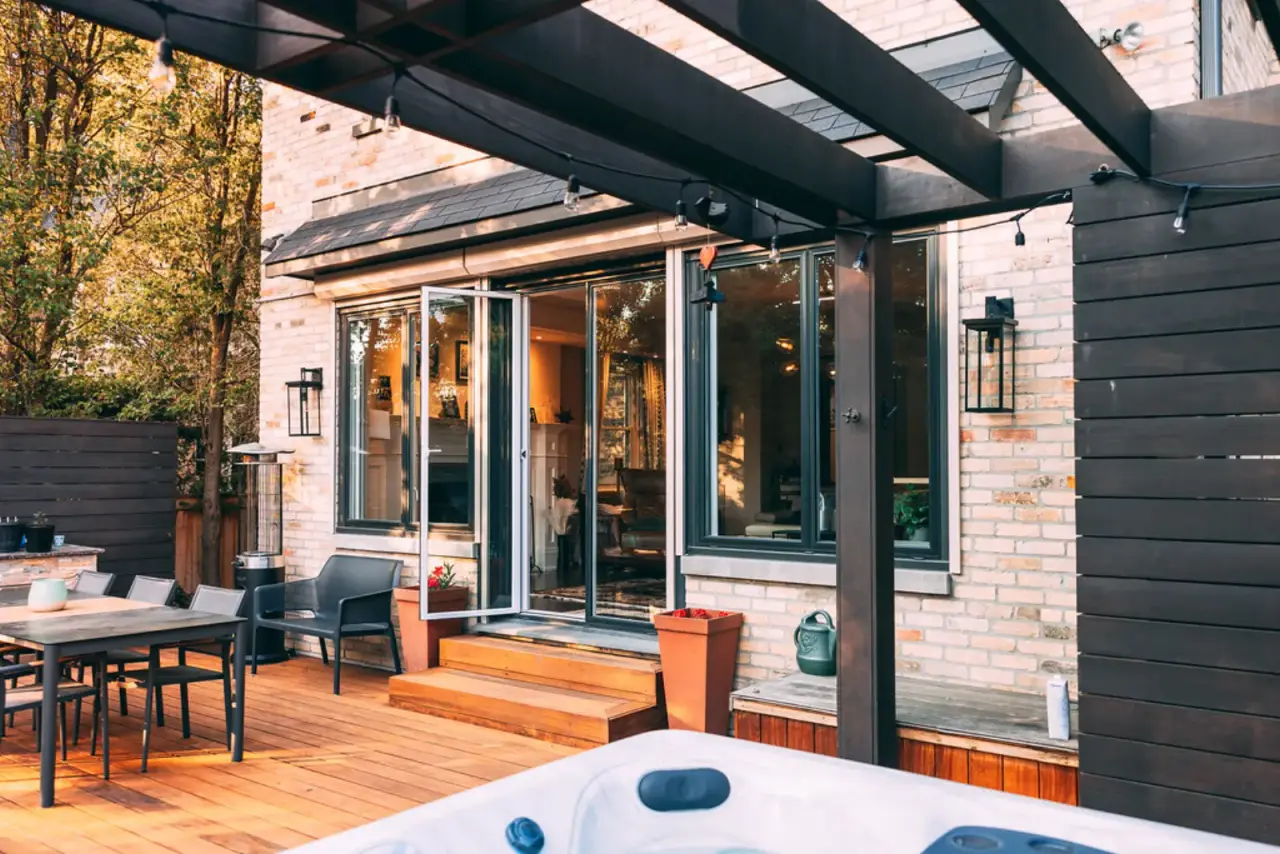
| Wood deck on engineered footings | A tub raised to deck height, next to the house door, or on a sloped lot. | Footings sized for the tub’s load, not the 40 to 43 psf default. Frost depth applies. |
| Wood deck or platform on helical piles | New decks where the soil is clay, fill or a mix, and where you want the load taken below the swelling layer. | Engineer’s pile layout, install torque and depth. Needs an inspection and a log. |
If you want the tub on grade, a properly built slab is the simplest answer and a concrete contractor should build it. Piles earn their place when the tub goes on a deck, because the deck’s footings are the weak link.
What Colorado ground does to the base
Denver’s frost line depth in Table R301.2 is 36 inches. R403.1.4.1 requires foundation walls, piers and other permanent supports of buildings and structures to be protected from frost, usually by extending below that depth. Deck footings carrying a tub are the kind of permanent support that rule is written for, so plan on taking them below frost. The code exempts small free-standing accessory buildings, but a deck is not one, so ask your building department how it treats yours.
Then there’s the clay. The Colorado Geological Survey says expansive soils can expand 10 percent or more as the clay gets wet, and the swelling can exert pressures of 20,000 pounds per square foot or more on foundations and slabs. Subsurface expansive soil in Colorado is usually fairly dry before construction starts, which is why wetting it later, with irrigation or a downspout, is what sets it off.
A hot tub is a rigid thing with 240-volt wiring and plumbing connected to it. A pad that rises and falls with the soil can strain those connections and throw the tub out of level. Hot Spring is clear that the spa must be level after installation so its internal plumbing drains. On our soils, getting the load below the swelling layer is a reason to look at deck footings or piles. Our article on Colorado soil conditions has more.
Where helical piles fit
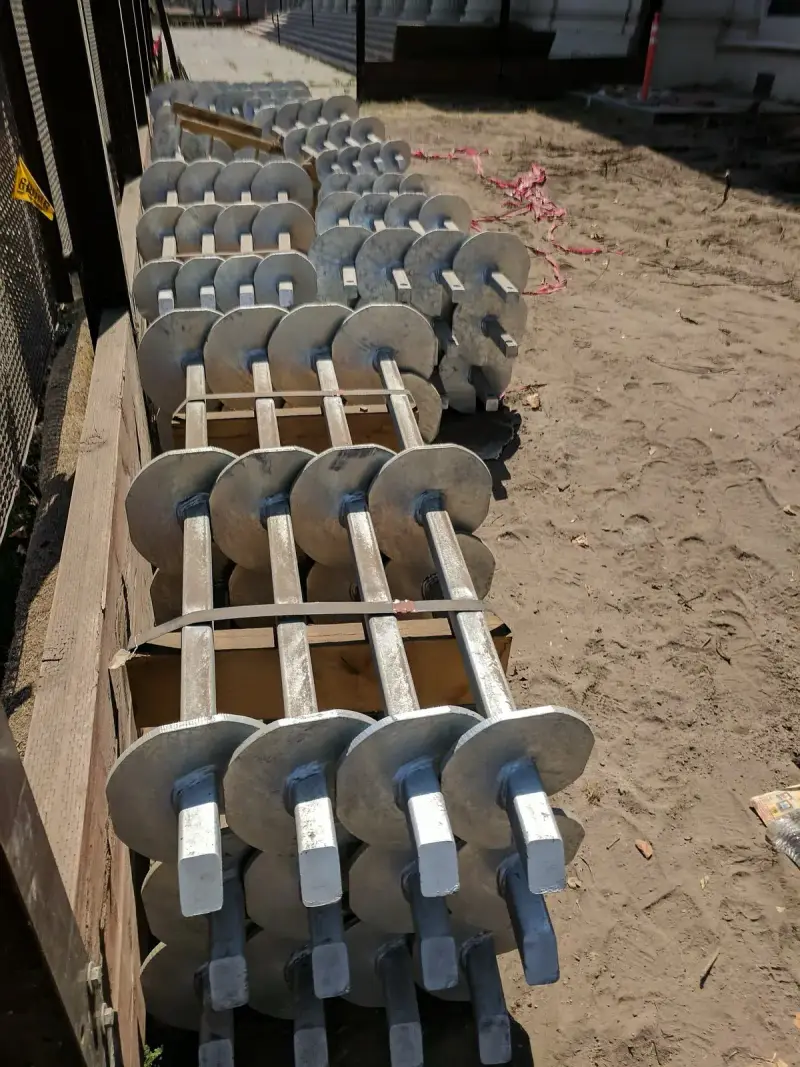
Helical piles are steel shafts with helical plates, turned into the ground until they reach the torque the engineer specified. ICC-ES AC358, the acceptance criteria that manufacturers’ evaluation reports are issued under, covers helical piles for compression, tension and lateral loads. For a hot tub deck, the engineer picks the pile spacing and depth for the tub load plus the deck, and the installer drives each pile to the specified torque and records it.
The practical advantages for a tub:
- The load goes to ground below the frost line and the swelling layer, not onto surface soil.
- There’s no cure time. A deck can be framed the same week the piles go in.
- No spoil to haul and no open holes in wet clay.
The limits are real too. Cobbles and shallow rock can stop a pile, and the work needs an engineer’s design. If you want the deck’s footing details, our guide to helical piles for decks covers them.
Permits, electrical and the day the tub arrives
Hot Spring’s booklet notes that in most cities and counties, permits are required for the electrical circuit and for exterior surfaces such as decks and gazebos, and some communities have barrier rules for spas. Its spec chart calls for a 230-volt, 50-amp GFCI-protected circuit on the models listed. That’s an electrician’s job. Call your building department before you order, because your lot’s rules decide the order of work.
A pre-delivery checklist for a new-build tub:
- Get the filled weight and psf from your model’s spec sheet.
- Decide: on grade (slab) or raised (deck).
- If a deck, have the footings designed for the tub’s load, not the default 40 to 43 psf.
- If a slab, specify at least 4 inches reinforced concrete over a compacted base.
- Confirm frost depth with your jurisdiction. Denver’s is 36 inches.
- Make sure the finished surface is level, with drainage away from the equipment compartment.
- Schedule the electrician and the permit before delivery.
- Keep irrigation and downspouts away from the base.
Working with Site Safe on a hot tub deck
Site Safe Helical Piers installs helical piles for new decks, additions, homes and commercial projects across Denver and the Front Range. We install to your engineer’s depth and torque and give you the installation log. See our services or contact us, or call 970-673-5615.