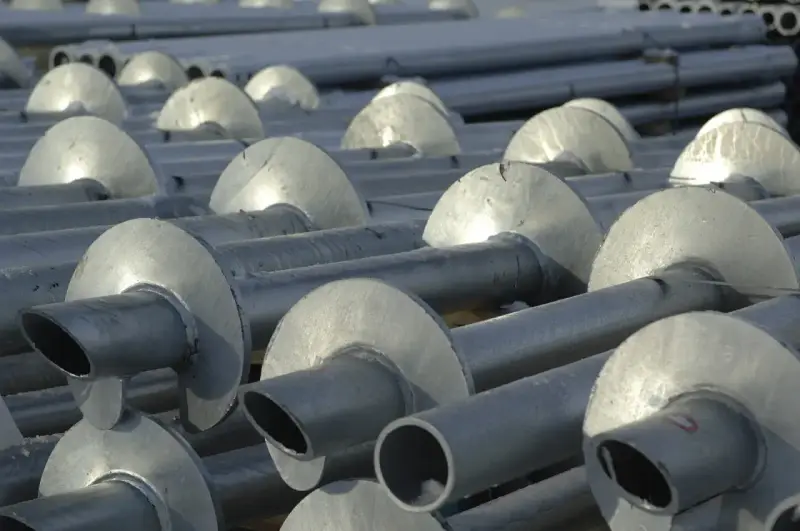
Galvanized helical piles are steel piles that have been dipped in molten zinc after the helix plates are welded on, so the shaft, the plates and the welds all carry the same coating. For a permanent foundation that coating matters in a measurable way. The evaluation criteria that helical piles are rated under (ICC-ES AC358) take a smaller corrosion deduction for zinc-coated steel than for bare or powder-coated steel, so a galvanized pile keeps more of its rated strength at the end of its 50-year design period. The size of that credit depends on how thick the zinc is, which many specs never state.
Below: which ASTM standard covers which part, how thick the zinc must be, field cuts, and what to ask for in the submittal on a new Front Range build.
What “galvanized” means on a helical pile
Hot-dip galvanizing means dipping the finished steel part in a bath of molten zinc. The zinc reacts with the steel and forms a series of zinc-iron alloy layers bonded to the surface, with a layer of pure zinc on top. Because the zinc is bonded to the steel and corrodes ahead of it, it also protects small bare spots next to it.
On a helical pile the order of work matters. The CHANCE evaluation report (ICC-ES ESR-2794) describes the shafts and helix plates as “hot-dipped galvanized as welded assemblies.” The plates are welded to the shaft first and the whole lead section goes into the kettle afterward. That puts zinc over the welds as well.
Which ASTM standard covers which part
Three coating standards come up on a helical pile job. AC358 accepts zinc coatings that comply with ASTM A123, A153, B633 or B695, “as applicable.”
| Part | Usual zinc standard | What it covers |
|---|---|---|
| Round-shaft pile sections (structural tube) | ASTM A123 (some reports cite A153 and A123 together) | Fabricated steel: shapes, plate, bar, pipe and tube |
| Square-shaft (solid bar) sections and helix plates | ASTM A153 in the CHANCE report | Hardware and forged or rolled articles |
| Coupling bolts and nuts | ASTM A153 Class C or D | Fasteners, by diameter |
| Pile caps (new construction brackets) | Hot-dip galvanized; the “G” suffix in the CHANCE catalog | Plates and sleeves |
Which one applies depends on the manufacturer’s evaluation report, so read the “Material Specifications” section of the report for the exact product you’re buying. In ESR-2794, the square-shaft models (SS5 and SS175) come either bare or galvanized, and catalog numbers ending in “NG” are nongalvanized. The round-shaft models listed there are galvanized only.
How thick does the zinc have to be?
ASTM A123 sets a minimum average coating “grade” in microns, based on the material category and the measured steel thickness. All of its values are minimums; the standard has no maximum. The American Galvanizers Association reproduces the table. The rows that matter for pile steel:
| Material (A123 Table 1) | Steel 1/8 to 3/16 in | Over 3/16 to 1/4 in | Over 1/4 to 5/8 in | Over 5/8 in |
|---|---|---|---|---|
| Pipe and tubing | 75 µm (3.0 mils) | 75 µm | 75 µm | 75 µm |
| Plate | 75 µm | 75 µm | 75 µm | 100 µm (3.9 mils) |
| Strip and bar | 75 µm | 75 µm | 75 µm | 100 µm |
| Structural shapes | 75 µm | 75 µm | 100 µm | 100 µm |
For fasteners under A153, Class C (bolts over 3/8 inch diameter) requires an average of 2.1 mils (53 µm), and Class D (3/8 inch and under) requires 1.7 mils (43 µm). Threaded areas aren’t subject to the thickness requirement.
The 86-micron line in AC358
AC358 links the corrosion deduction to the zinc thickness. When the specified zinc coating is 86 µm (0.0034 inch) or thicker, the sacrificial thickness over 50 years is 318 µm (0.013 inch). Below 86 µm, the deduction is interpolated between the zinc figure and the bare steel figure of 915 µm (0.036 inch), using the actual specified coating thickness.
Compare that with the A123 table. The minimum for pipe and tubing is grade 75, which is 75 µm, at every wall thickness in the table. A round-shaft pile galvanized only to the A123 minimum would fall under the 86 µm line, and its corrosion allowance would be interpolated rather than taken at 318 µm. The pile ratings depend on the coating thickness the report assumes, so that’s the number to check. Ask what minimum zinc thickness the evaluation report’s capacities assume, and ask the supplier for paperwork showing the galvanizer met it.
Galvanized vs bare steel: what changes in the numbers
The corrosion deductions in AC358, applied to every pile component before capacity is calculated:
| Coating | 50-year sacrificial thickness (AC358) | Notes |
|---|---|---|
| Zinc, 86 µm or more | 318 µm (0.013 in) | Base steel plus specified minimum zinc can count toward design thickness |
| Powder coat (at least 450 µm thick) | 671 µm (0.026 in) | Coating life taken as 16 years at most |
| Bare steel | 915 µm (0.036 in) | No coating credit |
ESR-2794 shows what that does to real products. For bare 3/8-inch helix plates on SS5 and SS175 shafts, the 50-year allowance leaves helix plate strengths at 88 percent of the galvanized values. For bare SS5 and SS175 lead shafts, the shaft strengths come out at 94 percent of the galvanized values. On a heavily loaded foundation, that gap can mean a bigger shaft or more piles.
Bare steel can suit temporary work, or a site where the engineer has checked the soil and accepts the larger deduction. For a permanent house, addition or commercial building, start from galvanized.
Rules for mixing coatings and touching metal
Two rules in AC358 and ESR-2794 catch people out on new construction:
- Don’t mix zinc-coated and bare components in one pile. If you do, the zinc-coated parts have to be designed with the bare-steel deduction (915 µm). A galvanized lead with a bare extension gives up the galvanizing credit.
- Keep the pile away from other metal. ESR-2794 says all helical foundation components must be galvanically isolated from concrete reinforcing steel, structural steel and other metal building components. Construction details have to say so. If a grade beam’s rebar is tied to the pile cap, the detail doesn’t meet the report. Show the separation on the cap drawing.
AC358 also says corrosion loss is counted whether the steel is below ground, above ground or cast in concrete. Galvanizing doesn’t get extra credit for the part of the pile inside the cap.
Field cuts, drilled holes and touch-up
A pile often reaches torque before the last extension is fully in the ground, so crews cut the shaft to elevation, and sometimes they drill it for a cap bolt. Each cut or hole exposes bare steel.
ASTM A780 is the standard for repairing galvanized coatings. It allows three repair materials: zinc-rich paint, zinc-based solder and sprayed zinc (metallizing). At the galvanizing plant, A123 limits repairs to areas no more than 1 inch across in the narrowest dimension, and no more than 0.5 percent of the accessible surface or 36 square inches per ton, whichever is less. After the steel is delivered there’s no maximum repair size, so damage in the field can be touched up whatever its size. The AGA stresses surface preparation: remove dirt and oil with solvent, then clean the area mechanically before applying the repair material.
In practice, a cut end that ends up deep inside the concrete cap is covered by the cap detail. A cut or drilled spot that stays exposed above the concrete, or sits in the soil just below it, needs A780 repair. The spec should say which.
What Colorado sites change
Most Front Range soils reports focus on swell and bearing capacity. Corrosion takes a few extra tests on samples the geotechnical engineer is already pulling: resistivity, pH, sulfates and chlorides. AC358 puts some conditions outside its scope altogether, including resistivity under 1,000 ohm-cm, pH under 5.5, sulfates over 1,000 ppm, landfill and mine waste. If the lot sits in an old mining area or on cut and fill, ask what’s in the ground before the piles are ordered. Outside those limits the engineer has to design corrosion protection for the site rather than rely on the standard ratings. Our page on soil testing before building a new home covers what the report includes.
Denver’s frost line is 36 inches, and the top of every pile passes through the disturbed soil around the cap. The pile still has to reach frost depth and its design torque whatever the coating; galvanizing affects how much steel the design counts on after the 50-year deduction.
Specification checklist for galvanized helical piles
Put these in the drawings or the submittal request:
- The product’s current ICC-ES evaluation report and model numbers, with the galvanized (not “NG”) catalog numbers.
- The zinc standard for each component (A123, A153), taken from the report.
- The minimum average zinc thickness the capacities assume, and the galvanizer’s certificate showing it was met.
- A note that zinc-coated and bare components won’t be mixed in one pile.
- Galvanic isolation between the pile and cap from rebar and other building steel, shown on the cap detail.
- Field repair of cuts and holes per ASTM A780, and where it applies.
- Soil resistivity, pH, sulfates and chlorides from the soils report, with confirmation they’re inside AC358’s limits.
For the wider design picture, see why helical piers suit Colorado soil conditions.
Planning a new foundation on helical piles?
Site Safe Helical Piers installs helical piles for new homes, additions, decks, solar and commercial projects in Denver and along the Colorado Front Range. Ask us about coating options for your project when you request an estimate. See our services, contact us or call 970-673-5615.