A good helical pile specification tells the installer three things in plain terms: which listed product to use, when each pile is done (a minimum depth and a minimum torque), and what records prove it. Everything else in the spec supports those three points. The building code makes this the designer’s job. IBC Section 1810.4.11 says helical piles shall be installed to the embedment depth and torsional resistance criteria “determined by a registered design professional”, and it never sets those numbers itself.
The specs that cause trouble at bid time are usually incomplete rather than wrong: loads but no torque, a torque with no definition, or a pasted model spec with someone else’s product names. Here’s how a helical pile specification is organized and why each part is there.
Where the requirements come from
Four documents drive almost every clause.
| Document | What it controls | Sections that matter |
|---|---|---|
| IBC (2024 edition, adopted by Denver as the 2025 Denver Commercial Building Code) | Design, allowable load, installation, special inspection | 1803.5.5, 1810.3.1.5, 1810.3.3.1.9, 1810.3.5.3.5, 1810.4.11, 1705.9 |
| ICC-ES AC358 (April 2025) | How manufacturers prove capacity, torque ratios, corrosion scope | Sections 3.13, 1.2, 6.10 |
| The manufacturer’s ICC-ES evaluation report (ESR) | Product capacities, installation and field QC rules for that system | Varies by product |
| The project geotechnical report | Bearing stratum, soil parameters, corrosion data, load test needs | Per IBC 1803.5.5 |
The Deep Foundations Institute’s helical piles committee also publishes guideline specifications for compression and tension work, a sensible starting point if you don’t have a master section.
Part 1, General: scope, references and submittals
Scope should say what the piles carry: compression, tension, lateral or a mix. Don’t leave tension out on the Front Range. The Colorado Geological Survey notes that swelling clay can push on foundations with pressures of 20,000 pounds per square foot or more, and a pile that passes through that clay can see uplift as the soil swells.
References: the IBC edition in force, AC358, the product’s ESR, ASTM A123 and A153 for galvanizing, and ASTM D1143, D3689 and D3966 for any load tests.
Submittals worth requiring before mobilization:
- the ESR number and the product data for the exact shaft, helix and cap you’ll accept
- installer qualifications, including any manufacturer certification the ESR requires
- a calibration certificate for the torque-measuring equipment
- the proposed installation equipment and its torque rating
- pile design calculations from the installer, if the spec is performance-based
That certification line isn’t boilerplate. Some evaluation reports make it a listing condition. ESR-2794, for example, requires at least one crew member to hold current manufacturer certification for basic training.
Design basis: what goes on the pile schedule
IBC 1803.5.5 lists what the geotechnical investigation must cover where deep foundations are used, including recommended foundation types and installed capacities, center-to-center spacing, installation procedures, load test requirements, suitability of materials for the environment and the bearing stratum. If the soils report on your project doesn’t address helical piles specifically, ask for an addendum before you write the spec.
Allowable load under IBC 1810.3.3.1.9 is half the ultimate capacity (Equation 18-4, Pa = 0.5Pu), where the ultimate is the least of the soil capacity from bearing plates and shaft friction, the capacity correlated from installation torque, the load test result where one is required, and the structural capacities of the shaft, couplings and helix plates. So the governing number can be a steel limit, not the soil.
For each pile or pile type, the schedule should give:
- design load in compression and, where applicable, tension and lateral
- minimum tip embedment depth
- minimum effective installation torque (the termination criterion)
- maximum depth, if there’s a reason to cap it
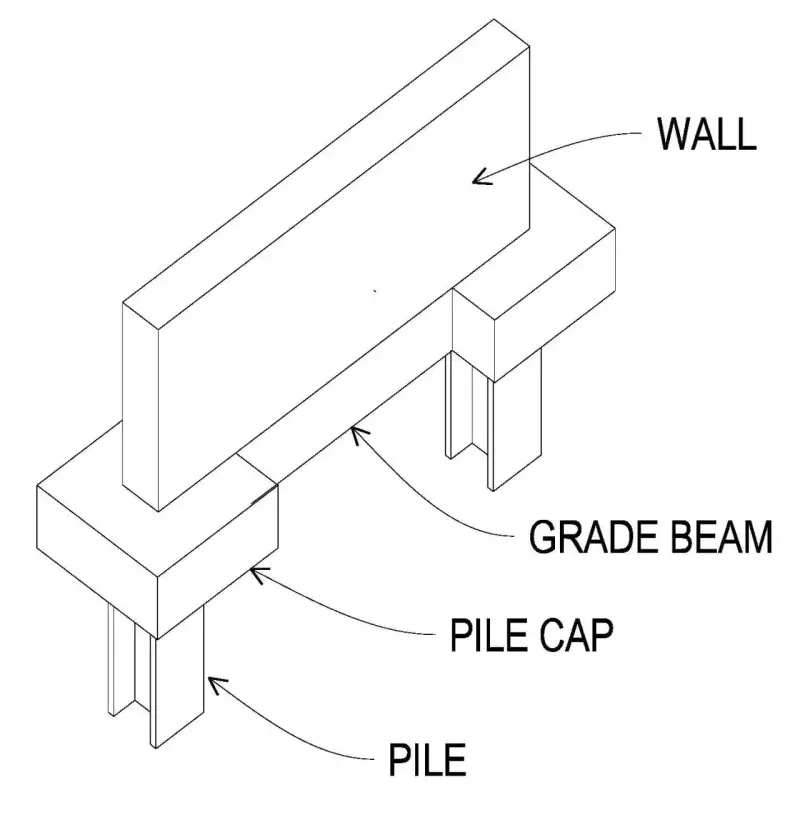
- pile cap or bracket model and its connection detail
How the termination torque is calculated
Torque-to-capacity correlation is the reason helical piles are practical. AC358 publishes default capacity-to-torque ratios (Kt) for common shafts:
| Shaft | Default Kt (ft⁻¹) |
|---|---|
| 1.5 in and 1.75 in square | 10 |
| 2.875 in OD round | 9 |
| 3.0 in OD round | 8 |
| 3.5 in OD round | 7 |
Manufacturers can establish other values through testing, so use the Kt in the ESR for the product you specify. ESR-2794 writes the termination criterion as Treq = F.S. × Qall / Kt. Take a 2.875-inch round shaft with a 20,000 lb allowable load and a factor of safety of 2: 2 × 20,000 / 9 works out to roughly 4,450 ft-lb. That number goes on the drawings.
Spell out how “effective torque” is measured. Under ESR-2794 it’s the final reading for a single-helix pile in compression, and the average of the last three readings taken at 1-foot intervals over the final 2 feet for multi-helix piles and any pile in tension. If the spec just says “install to 4,500 ft-lb”, two installers can read that two ways.
Part 2, Products
IBC 1810.3.5.3.5 only says the shaft and helix plates must be sufficient for the design loads. The spec has to be more specific than that:
- manufacturer and system, with the ESR number, or an “or equal” clause that requires an ESR under AC358 with equal or higher capacities
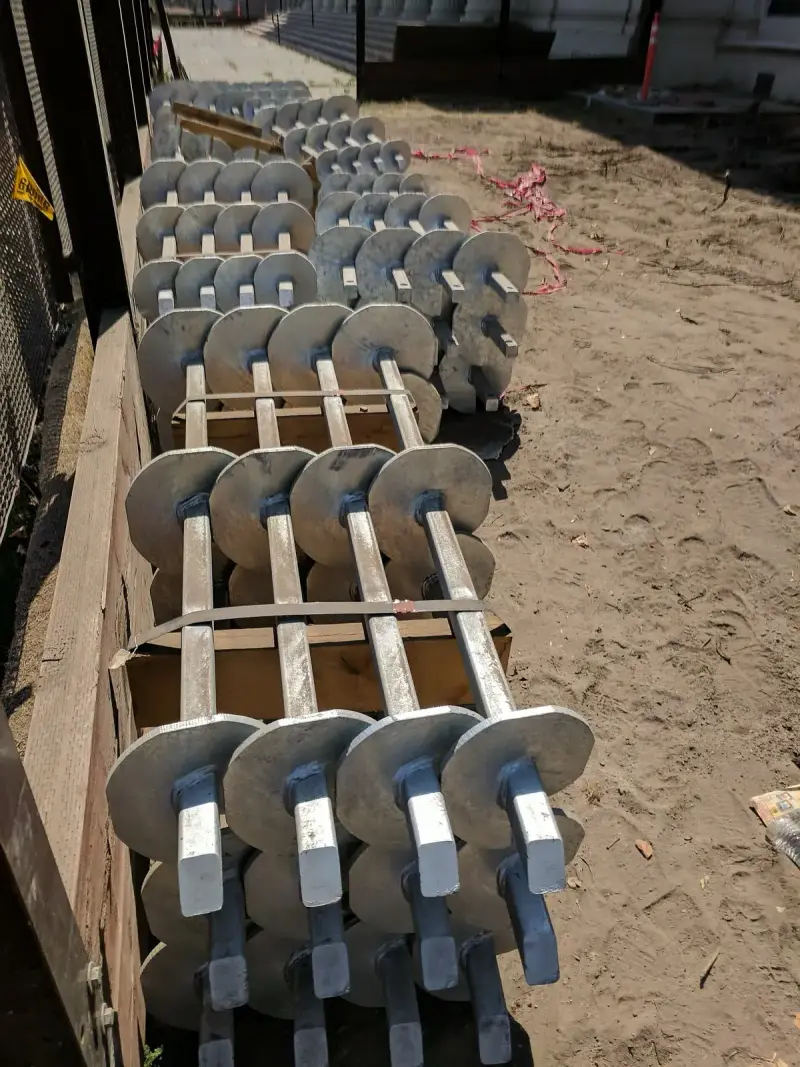
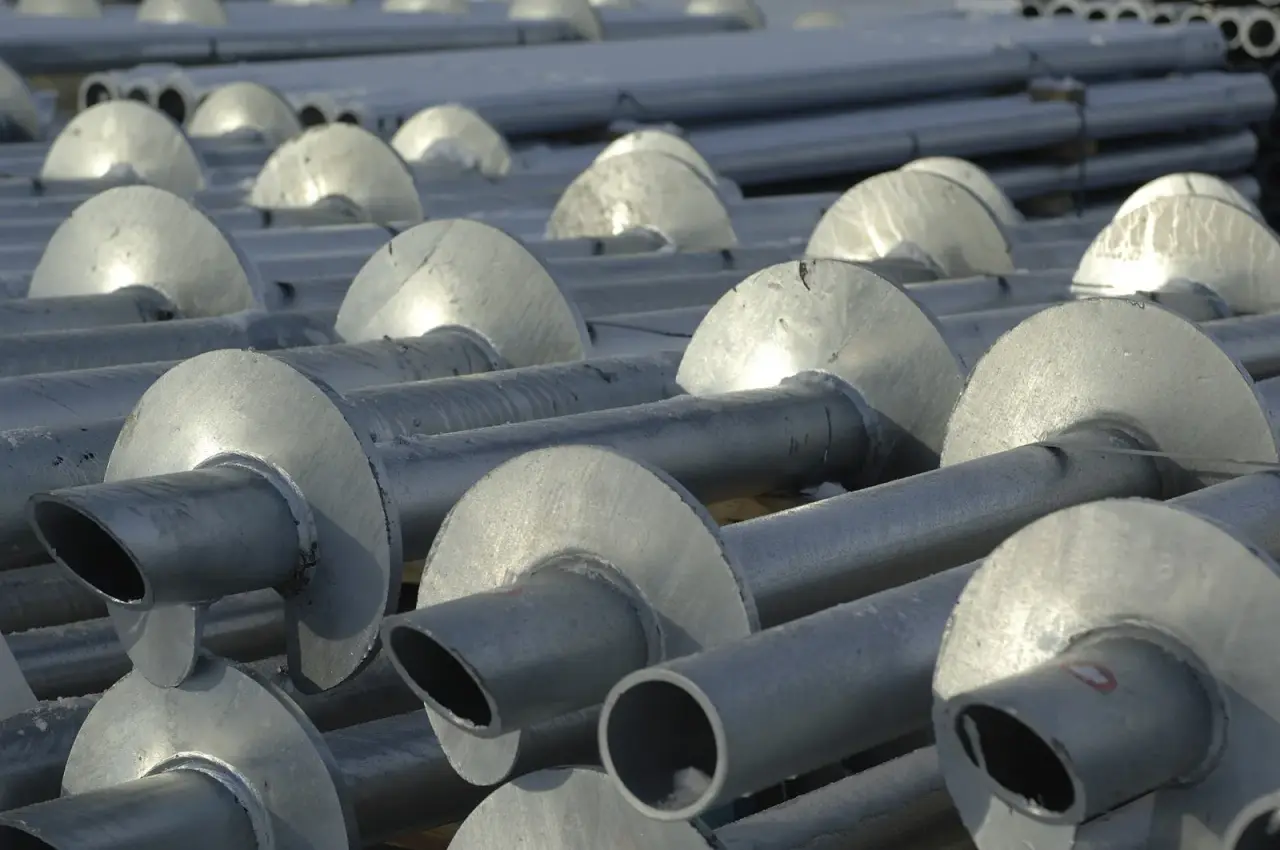
- shaft size and wall thickness, helix count, diameters and spacing
- coating: bare, or hot-dip galvanized to ASTM A123 (shafts and plates) and A153 (hardware)
- new-construction pile caps sized for the grade beam or column load
Corrosion needs a sentence of its own. AC358 places soils outside the scope of an evaluation report when resistivity is below 1,000 ohm-cm, pH is below 5.5, sulfates exceed 1,000 ppm, organic content is high, or the site is a landfill or holds mine waste. Ask the geotechnical engineer for resistivity, pH and sulfate results, and say what happens if they fall outside those limits. In that case the product’s evaluation report no longer covers the installation, and the engineer has to address corrosion directly. ESR-2794 adds two practical rules: don’t mix coating types in one pile, and keep the piles out of electrical contact with rebar and other building steel.
Part 3, Execution
Termination. A pile is complete when it has reached both the minimum depth and the minimum torque. Say what happens when it reaches torque early (stop at the maximum rated torque and notify the engineer; never over-torque to make depth) and when it reaches depth without torque (add extensions until torque is reached, up to any maximum depth, then call the engineer). IBC 1810.4.11 prohibits exceeding the manufacturer’s rated maximum installation torque.
Torque monitoring. Require continuous monitoring with a calibrated indicator. ESR-2794 requires calibration within the previous 12 months, readings recorded at intervals of no more than 5 feet through the whole installation, and a rotation speed between 5 and 25 rpm while advancing 2.5 to 3.5 inches per revolution. Copy the field QC rules from the ESR you’re using rather than inventing your own.
Alignment and location. Give the plan tolerance and the inclination. ESR-2794 permits 0° ± 1° from vertical for new-construction pile caps. If a pile has to be battered for lateral load, show the angle on the drawings.
Tension piles. AC358 and ESR-2794 both require the uppermost helix to be at least 12D below grade for tension applications, where D is the largest helix diameter, unless the design professional sets a site-specific depth that the code official approves.
Spacing. AC358 requires a group-effect analysis when axially loaded piles are closer than three times the largest helix diameter, center to center. Put the minimum spacing on the plan.
Cutoff and caps. State the cutoff elevation, how the cap attaches, and the minimum embedment of the cap in the concrete. The concrete contractor’s forms, rebar and pour come after the pile work, so coordinate the cap detail with the grade beam reinforcing.
Inspection, records and load tests
IBC 1705.9 requires continuous special inspection during helical pile installation. The special inspector records the installation equipment, pile dimensions, tip elevations, final depth, final installation torque and other data the design professional asks for, and compares them against the approved geotechnical report and construction documents. Require an installation log that matches those items.
Load tests are required by IBC 1810.3.3.1.2 where design loads exceed the code’s allowable stresses or where the design load for any element is in doubt, with at least one test in each area of uniform subsoil conditions. Cite ASTM D1143 for compression and D3689 for tension, and state who pays, who witnesses and what deflection counts as failure.
Colorado notes for Front Range projects
Expansive clay and claystone change a few lines. Design piles for uplift from swelling soil as well as building loads, with an uplift value or a minimum depth below the active zone from the geotechnical report. Detail a void space under grade beams where the soils report calls for one. Caps and beams still have to respect the local frost depth (Denver’s code lists 36 inches). Front Range jurisdictions adopt different code editions, so check with your local building department on special inspection.
Our article on geotechnical testing in commercial construction covers what to ask for in the soils report, and how helical pier installation works shows what the crew does on site.
Pre-bid checklist for your helical pile specification
- ESR number or an “or equal” clause tied to AC358
- Design loads by direction for every pile type
- Minimum depth and minimum effective torque on the drawings
- Definition of effective torque (single reading or average of last three)
- Kt value and factor of safety used, or a note that they come from the ESR
- Coating and corrosion criteria, with the soil test values that trigger a different design
- Inclination, location and spacing limits
- 12D rule or an engineered depth for tension piles
- Calibration certificate as a submittal
- Special inspection per IBC 1705.9 and the log format
- Load test triggers, method and acceptance criteria
- Instructions for early refusal and for low torque at depth
- New-construction cap model, cutoff elevation and embedment in concrete
Talk to the installer before you issue the spec
Site Safe Helical Piers installs helical piles for new buildings, additions, decks and commercial work across Denver and the Colorado Front Range. If you’re writing a helical pile specification and want a field read on torque criteria, equipment access or cap details before it goes to bid, see our services or call 970-673-5615. We’re happy to review a draft pile schedule with your engineer.