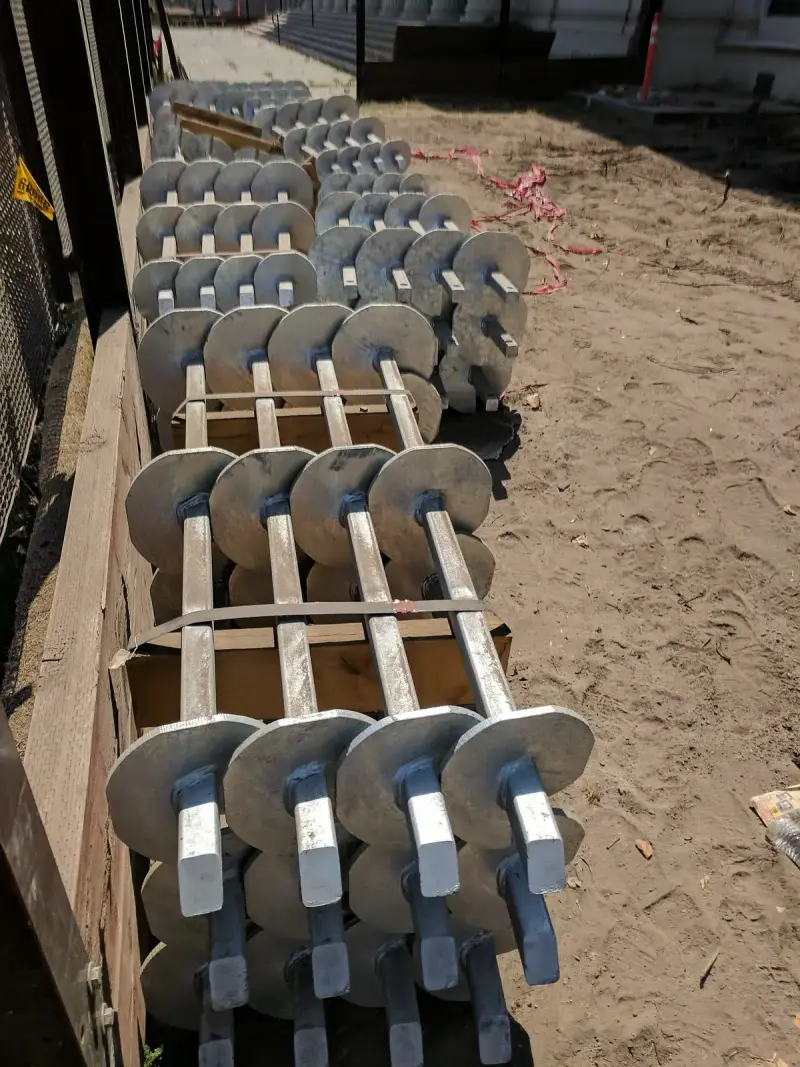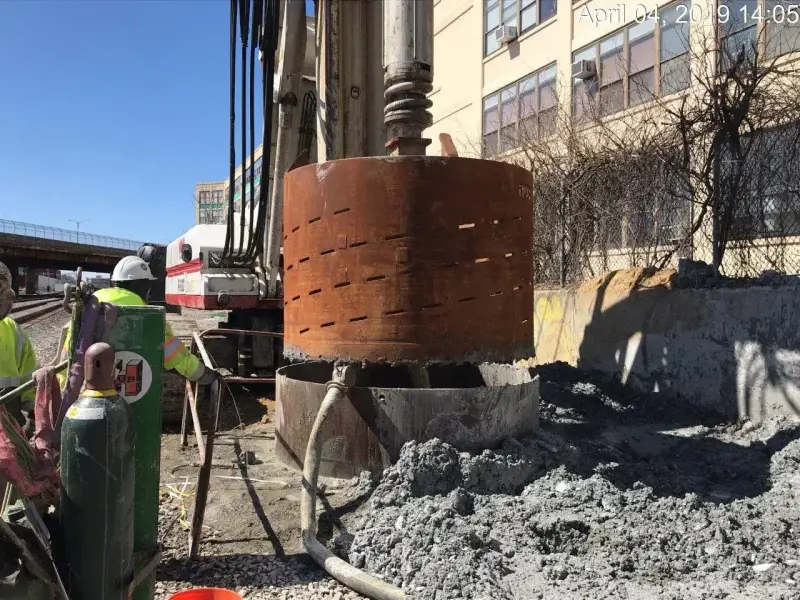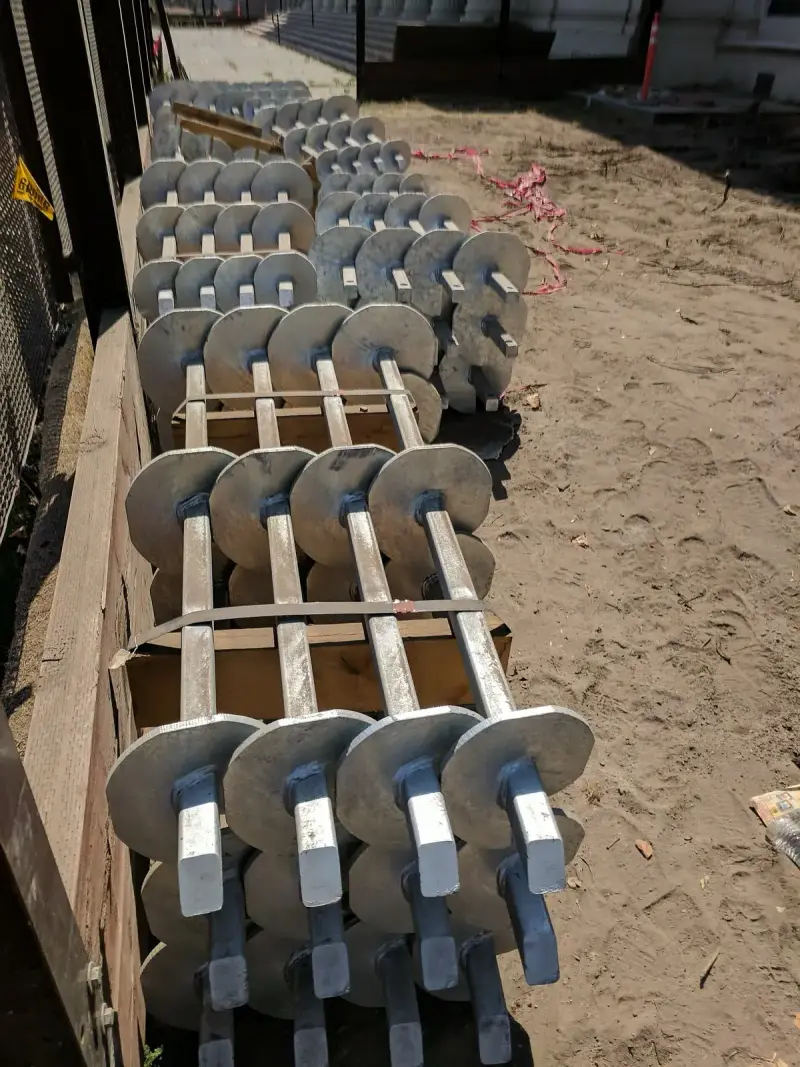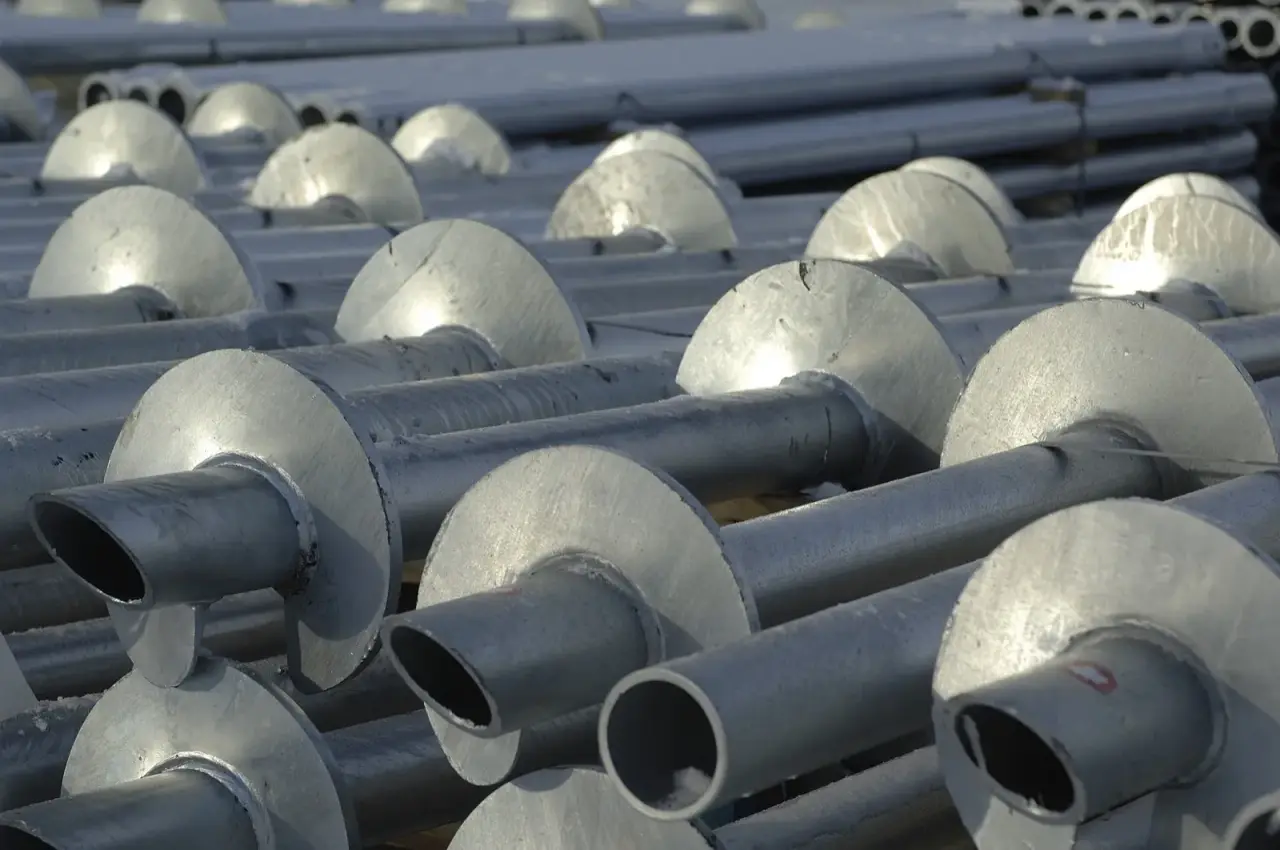
The main pros of helical piers are speed, small equipment, no curing time, and a capacity you can check pile by pile from the installation torque. The main cons are that they need an engineer and a soils report to be done right, they don’t like cobbles and boulders, their slender shafts give limited lateral resistance on their own, and the per-pile price can be higher than a simple footing on good ground. On the Front Range, where swelling clay is common, the pros usually win for homes, additions and decks. On a flat lot with stable, sandy soil, they often don’t.
What a helical pier actually is
A helical pier (or helical pile; the terms are used interchangeably) is a steel shaft with one or more helix plates welded near the tip. A machine screws it into the ground, adding extension sections until it reaches the depth and resistance the engineer specified. The top gets a new-construction bracket or cap that is cast into the footing, grade beam or pile cap.
The International Building Code covers helical piles as a deep foundation type in Section 1810, and Section 1810.4.11 says they must be installed to the embedment depth and torsional resistance criteria set by a registered design professional (UpCodes, IBC helical piles). Products are evaluated under ICC-ES acceptance criteria AC358, which is what manufacturers’ evaluation reports (ESRs) are written against (ICC-ES AC358).
The pros of helical piers
Capacity is verified on every pile
This is the advantage most sales pages skip, and it’s the one engineers care about most. Installation torque correlates with capacity. AC358 sets default torque-to-capacity factors (Kt) by shaft size: 10 per foot for 1.5- and 1.75-inch square shafts, 9 for 2.875-inch round, 8 for 3.0-inch round and 7 for 3.5-inch round. Capacity from that correlation is an ultimate value, and the allowable load uses a factor of safety of 2 (AC358).
So if a pile won’t reach its target torque, everyone knows on the spot. With a drilled caisson or a spread footing, you’re relying on the soils report and the inspector’s eyes at the bottom of the hole.
No cure time, and they work in cold weather
Steel carries load as soon as it’s installed. There is no waiting for concrete in the pile itself, which helps on a tight schedule and in winter, when the frozen crust is a nuisance rather than a stop. The caps and grade beams on top are still concrete and still follow normal cold-weather practice.
Small rigs and very little spoil
Helical piles are screwed in, not drilled, so there’s almost no dirt to haul off. The Hubbell/Chance design manual describes them as able to go anywhere a soil boring can be taken, and notes installs inside occupied buildings without interrupting normal use (CHANCE Technical Design Manual). For a new addition beside an existing house, an alley-access ADU, or a deck in a finished backyard, that matters more than almost anything else.
They suit swelling clay
The Colorado Geological Survey says expansive soils can exert pressures of 20,000 pounds per square foot or more on foundations (CGS, Expansive Soil and Rock). The design answer is to bear below the active zone and limit how much of the foundation the swelling soil can grab. The Chance manual makes the point that a helical pile’s small shaft gives swelling clay less surface area to push on, and notes that void forms under grade beams are a typical Denver detail (CHANCE Technical Design Manual).
The cons of helical piers
Cobbles, boulders and rock stop them
A helix plate has to cut through the ground. Fill full of concrete rubble, river cobbles or a boulder layer can bend a plate or spike the torque reading before the pile reaches good soil. The Chance manual lists boulders, rubble fill and cemented soils as barriers that may require pre-drilling, and notes that design changes such as pre-drilling or a different shaft may be needed to reach the bearing layer in hard clays, cemented sands or weathered rock (CHANCE Technical Design Manual). It also says torque spikes from obstructions must be ignored when judging whether a pile has met its torque criterion. A pile that “hit torque” on a rock at 4 feet hasn’t really met anything.
If the boring logs show cobbles along a creek or the South Platte, budget for pre-drilling or a different foundation.
Limited lateral resistance on their own
Most helical piles have slender shafts, and the Chance manual says those shafts offer limited resistance to lateral loads when installed vertically (CHANCE Technical Design Manual). For a house that’s handled by the structure: the grade beams and walls brace the pile tops. For a tall freestanding sign, a retaining wall or a pole structure with big wind loads, the engineer may need battered piles, larger shafts or a different system.
Soft ground changes the math
A slender pile can buckle where the soil around it gives no support. The Chance evaluation report defines firm soil as a Standard Penetration Test blow count of 5 or more, soft soil as 1 to 4, and fluid soil as zero, and says shaft capacity in air, water or fluid soil is not covered by its tables and must be worked out by a design professional (ICC-ES ESR-2794). Near water, in loose fill or in organic soil, ask about it.
Corrosive soils are outside the standard
Steel corrodes. AC358 handles this by subtracting a sacrificial thickness over a 50-year period from every component before calculating capacity, and it excludes some ground entirely: soil resistivity below 1,000 ohm-cm, pH below 5.5, high organic content, sulfates above 1,000 ppm, landfills and mine waste (AC358). Those sites need a site-specific corrosion design or another foundation type.
You need paperwork and a specialist crew
A helical pile foundation isn’t a handshake job. Under the IBC it needs an engineer’s design and special inspection under Section 1705.9, and the Chance ESR lists what the inspector checks, including the installer’s certification, the equipment, final depth and final torque (ESR-2794). That’s a feature, but it’s also cost and coordination a homeowner doesn’t always expect.
Price per support can be higher
On a flat lot with stiff, non-expansive soil and easy truck access, a simple concrete footing is often cheaper. Helical piles start to win on cost when you add swelling clay, a slope, tight access, winter scheduling or a lot of excavation and haul-off. Our helical pile cost guide walks through what drives the number.
Pros and cons at a glance
| Factor | Helical piers | What to watch |
|---|---|---|
| Capacity check | Torque logged on every pile, tied to AC358 Kt factors | Torque spikes from rocks don’t count |
| Schedule | Load-ready on install; no pile cure | Caps and beams still need concrete cure |
| Access | Mini-excavator or skid-steer sized equipment, little spoil | Overhead lines and buried utilities still limit placement |
| Swelling clay | Small shaft, bears below the active zone | Active-zone depth must come from the soils report |
| Cobbles and rock | Can need pre-drilling or redesign | Read the boring logs before bidding |
| Lateral load | Limited on a single vertical shaft | Braced by the structure, or engineered for it |
| Corrosion | 50-year sacrificial allowance built into ratings | Low-resistivity, acidic or high-sulfate soils are outside AC358 |
Which projects suit helical piers
| Project | Usually a good fit? | Why |
|---|---|---|
| New home on swelling clay | Yes | Bears below the active zone; pairs with void-formed grade beams |
| Addition next to an existing house | Yes | Small rig, no vibration, no big excavation against the old footing |
| Deck, porch or pergola | Yes | Quick, no concrete trucks, reaches frost depth easily |
| Hillside or mountain lot | Usually | No cut-and-fill for each footing; access is the limiter |
| Garage or ADU on a tight lot | Usually | Alley access and little spoil |
| Building on cobbly river terrace | Sometimes | Pre-drilling or another system may be cheaper |
| Tall sign, pole or wall with big lateral load | Sometimes | Needs engineered lateral design |
| Heavy column loads in commercial work | Depends on the design | Typical working loads per pile are under 100 kips; heavier loads need groups or other systems |
That last row comes from the Chance manual, which says working loads per foundation in normal soil are typically under 100 kips, with special cases going higher (CHANCE Technical Design Manual).
When we’d tell you to pour concrete instead
Plenty of projects are better off with a conventional footing. We’d say so if:
- The soils report shows stable, non-expansive bearing soil near the surface and the frost depth is easy to reach.
- The boring logs show cobbles or shallow bedrock across most of the footprint, so every pile would need pre-drilling.
- The structure is mostly lateral load (a tall freestanding wall or sign) and the engineer prefers a drilled shaft.
- The soil tests fall outside AC358’s corrosion limits and nobody wants to engineer around it.
If you’re comparing the two directly, our post on helical piers vs concrete footings in Colorado goes deeper.
Talk to an installer
Site Safe Helical Piers installs helical piers for new homes, additions, decks and commercial projects across Denver and the Colorado Front Range. We work on new construction only, and we don’t pour the concrete; we set the piles your engineer designs and hand over the log. If you’re weighing piles against concrete for a new build, call 970-673-5615 or send us your plans and soils report, and see our services page for the project types we cover.