A high water table means the ground is saturated close to the surface, so any excavation for a footing, basement or pier can fill with water before the concrete goes in. You can still build. The foundation just has to be planned around the water: keep excavations shallow or avoid them, take loads to soil that isn’t softened by saturation, and keep the building’s floors and walls dry. Deep foundations installed without open holes, such as helical piles, are one of the simpler ways to do that.
What a high water table actually is
The USGS defines the water table as the top of the saturated zone, the depth below which the spaces between soil grains are full of water. Above it is the unsaturated zone. The water table isn’t fixed. The USGS describes it as a surface that fluctuates seasonally and from year to year with recharge from precipitation and nearby surface water, and it typically rises in late winter and spring when snow melts.
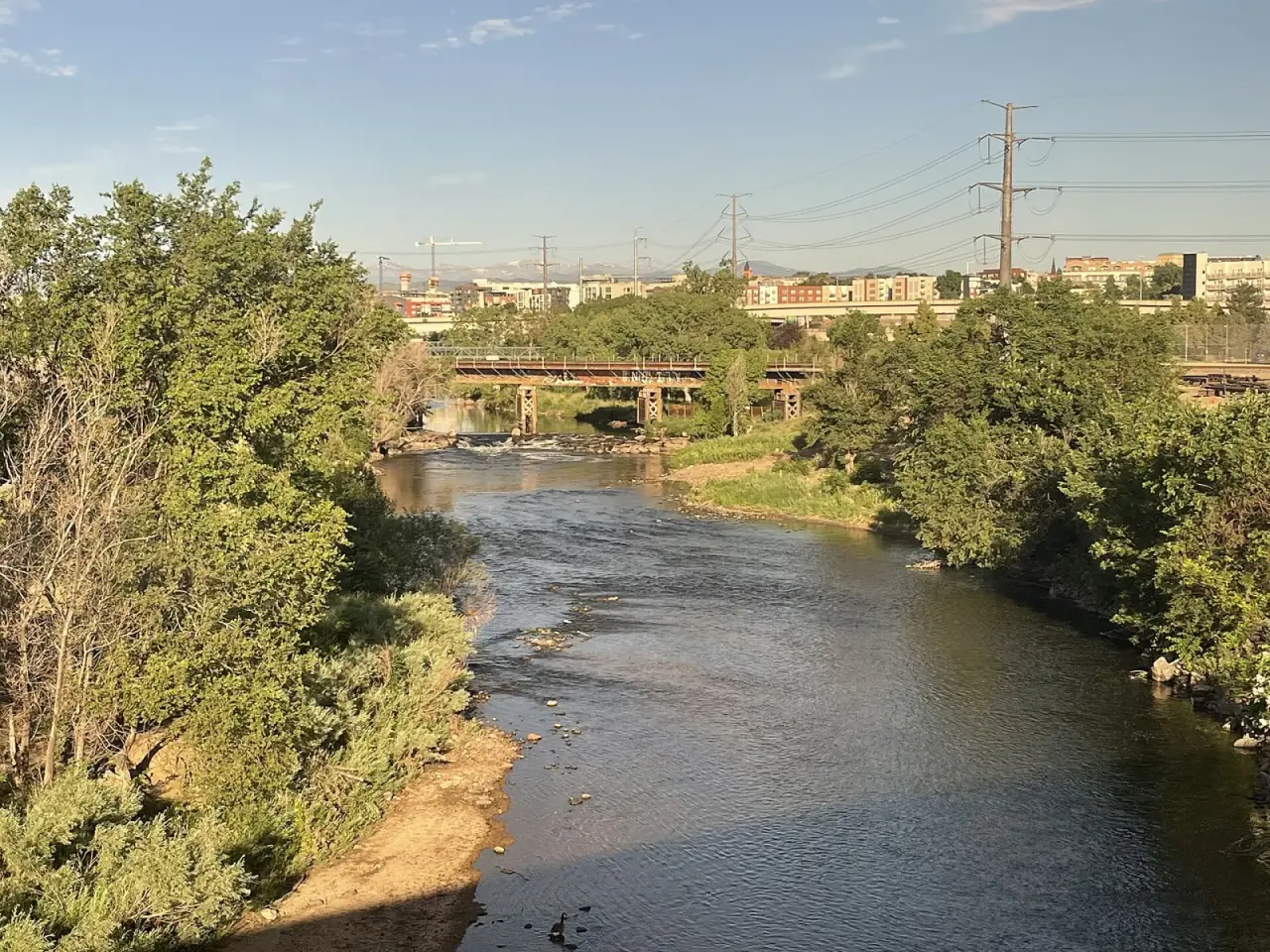
That seasonal swing matters for Colorado builders. A boring drilled in a dry September can show water at one depth. The same hole in May, during runoff, could show it a few feet higher. Lots along the South Platte, Clear Creek, Sand Creek and other drainage corridors around Denver and Commerce City are the usual places shallow groundwater turns up, along with low spots fed by irrigation ditches.
How shallow groundwater affects a new foundation
| Problem | What happens on site | Why it matters |
|---|---|---|
| Flooded excavations | Footing trenches and basement holes fill with water. Sides slough in | Pumping, shoring and lost days. Concrete can’t go into standing water without special methods |
| Softened bearing soil | Saturated soil at footing level loses strength. Clay turns to mud under equipment | Spread footings may need to be wider or deeper, or bear somewhere else |
| Uplift on below-grade floors | Water pressure pushes up on basement slabs | Basements may need waterproofing, drainage or extra weight to resist buoyancy |
| Wet concrete placement | Drilled piers can cave or fill with water before the pour | Slurry, casing or tremie methods add cost and inspection |
| Swelling clay | Rising water and wetting fronts feed expansive clay | CGS notes clay can expand 10 percent or more as it gets wet |
| Corrosion | Steel in permanently wet or aggressive soil corrodes faster | Steel elements need corrosion allowance or protection designed in |
What the code requires when groundwater is shallow
The International Building Code (Denver’s 2025 commercial code is based on the 2024 IBC) addresses groundwater directly in Chapter 18. Your jurisdiction may amend these, so confirm with the local building department.
- Section 1803.5.4 requires a geotechnical investigation to determine whether groundwater is above, or within 5 feet below, the lowest floor level where that floor is below the adjacent finished ground.
- Section 1805.1.3 allows walls and floors to be dampproofed instead of waterproofed when the groundwater table is lowered and kept at least 6 inches below the bottom of the lowest floor.
- Section 1805.3 requires walls and floors to be waterproofed where hydrostatic pressure exists, with the membrane carried from the bottom of the wall to at least 12 inches above the maximum groundwater elevation.
On residential work the IRC has parallel dampproofing and waterproofing rules. In practice the first decision is usually whether the house needs a basement at all. On a lot with groundwater a few feet down, a crawlspace or slab-on-grade over a deep foundation avoids most of the water fight.
How to read groundwater in a soils report
Your geotechnical report should tell you more than “water encountered.” Look for:
- Depth at drilling and depth after. Many logs record water at the time of drilling and again a day or more later. The later reading is often closer to the real level, because water takes time to seep into a fresh hole.
- Date of drilling. Compare it to runoff season. A reading taken in a dry fall may understate the spring water table.
- Monitoring wells or piezometers. On larger projects, a standpipe left in the boring lets you measure water over weeks.
- Soil type at and below the water. Sand and gravel give up water quickly and cave. Saturated clay is soft but holds a hole longer.
- Recommendations. The engineer should say whether to avoid basements, how deep foundations should go, what dewatering is needed and whether the soil is corrosive.
If the report doesn’t cover groundwater clearly, ask before you design. Our post on why soil testing comes first on a new home explains what a full report includes.
Foundation options on a high water table
| Option | How it handles groundwater | Trade-offs |
|---|---|---|
| Slab-on-grade, no basement | Keeps the excavation above the water | Slab still bears on near-surface soil. Needs good drainage and, on clay, may still move |
| Spread footings with dewatering | Pumps the excavation dry long enough to pour | Pumping costs, possible discharge permits, and saturated soil at bearing level |
| Basement with waterproofing and drains | Builds a watertight box with drainage | Highest cost and ongoing reliance on drains and pumps where water sits above the floor |
| Drilled concrete piers | Takes load deep | Holes can cave or flood. May need casing, slurry or tremie placement |
| Helical piles with grade beam or structural floor | Screwed in without an open hole, so there’s nothing to flood or collapse | Steel needs corrosion allowance. Very loose saturated soil may need longer piles to reach design torque |
Helical piles avoid the open-hole problem because the pile displaces soil as it’s turned in. Capacity is confirmed by installation torque at each pile, so the crew knows during installation whether a pile has reached competent soil below the soft, saturated layer. That’s the same reason helical piles are used for docks and bridges in wet ground; see helical piles for docks and bridges.
Corrosion: the question to ask about steel in wet ground
Galvanized steel holds up well in most Front Range soils, but permanently wet or chemically aggressive soil speeds up corrosion. ICC-ES acceptance criteria AC358, the basis for code-listed helical pile systems, places some conditions outside the normal scope of its evaluations: soil resistivity below 1,000 ohm-cm, pH below 5.5, high organic content, sulfate concentrations above 1,000 ppm, landfill sites and mine waste. If your soils report shows any of those, the engineer needs to design for it with extra steel thickness, coatings or a different foundation. Ask that the soils lab run resistivity, pH and sulfate tests when groundwater is shallow.
Talk to us about a wet site
Site Safe Helical Piers installs helical piles for new homes, additions, decks and commercial buildings across Denver and the Front Range, including river-corridor sites in Commerce City. If your soils report shows shallow groundwater, send it with your plans through our services page or call 970-673-5615, and we’ll talk through whether piles fit the engineer’s design.