Frost heave is the upward movement of the ground when water in the soil freezes into layers of ice, called ice lenses, that keep growing by drawing more water up from the unfrozen soil below. Anything resting in that freezing zone, like a shallow footing, a deck post or a slab edge, gets lifted, often unevenly, and doesn’t always settle back where it was. Foundations avoid it by bearing below the frost line, by insulating the ground so it doesn’t freeze, or by sitting on something frost can’t move, such as rock or a deep pile.
Here’s how the process works, which soils are worst, and what that means for a new build in Colorado.
What causes frost heave
Three things have to be present at once. The FHWA’s geotechnical pavement manual lists them as frost-susceptible soil, subfreezing temperatures in the soil, and a source of water (FHWA NHI-05-037, Ch. 7). Take away any one and heave doesn’t happen.
The common explanation, that water expands when it freezes, is only a small part of it. The bigger effect is water migrating. As the freezing front moves down, unfrozen water is pulled up toward it and freezes onto growing ice lenses. In one 2023 lab study on silty clay, the water content near the freezing front climbed to 53.4 percent in untreated soil, from a starting water content of 25 percent (Ji et al., 2023). That extra water, now ice, is what pushes the ground up.
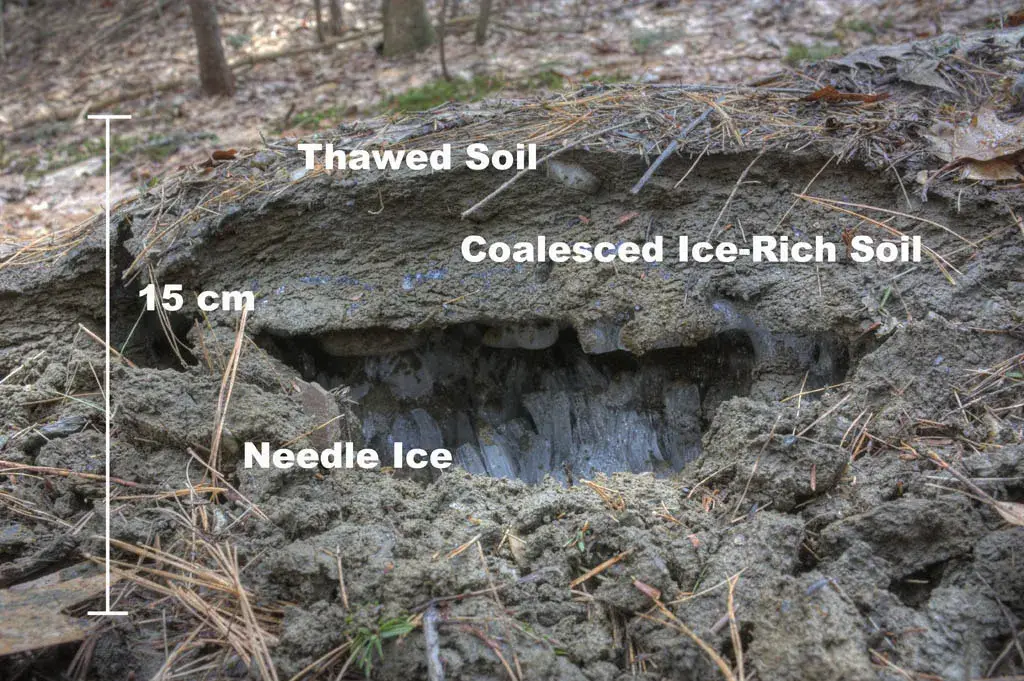
The photo above shows it clearly: needle ice growing up from the freezing front, with a lifted layer of ice-rich soil on top.
Which soils heave the most
Fine soils with the right pore size are the worst. They’re tight enough to pull water up by capillary action but open enough to let it move. The FHWA manual groups soils into four frost-susceptibility classes based on fines content:
| Class | Frost susceptibility | Typical soils |
|---|---|---|
| F1 | Negligible to low | Gravelly soils with 3 to 10 percent fines |
| F2 | Low to medium | Gravelly soils with 10 to 20 percent fines; sands with 3 to 15 percent fines |
| F3 | High | Gravelly soils over 20 percent fines; sands over 15 percent fines; clays with PI over 12 |
| F4 | Very high | All silts; very fine silty sands over 15 percent fines; clays with PI under 12 |
Source: FHWA NHI-05-037, Ch. 7. “Fines” means material passing the 0.075 mm sieve, and PI is the plasticity index.
The same manual treats a water table within about 3 meters (10 feet) of the surface as a high frost hazard, since it keeps feeding the ice lenses. Clean, free-draining gravel barely heaves; a silty yard next to a downspout heaves a lot.
What frost heave does to a foundation
There are two ways it gets hold of a structure.
Heave under the footing. If the bottom of a footing sits in soil that freezes, the ice lenses form underneath it and lift it. A light structure’s weight won’t hold it down, so the practical defense is to keep the bearing surface out of the freezing zone.
Adfreeze on the sides. Frozen soil can bond to the side of a post, pier or pile and drag it upward as the frozen layer heaves. The Chance design manual names adfreeze from seasonally frozen ground as one of the uplift forces deep foundations must resist, and notes that on expansive clay the swelling pressure can far exceed it (CHANCE Technical Design Manual). It’s why a deck post set in a shallow concrete plug can “jack” a little higher every winter: the plug gets gripped, lifted, and never quite drops back.
The damage shows up as doors and windows that bind in winter and free up in spring, deck boards that hump at a post, garage slabs that crack near the edge, and fence posts that lean.
How the code protects foundations from frost
Denver’s residential code, like the IRC it’s based on, requires foundation walls, piers and other permanent supports to be protected from frost by one of four methods (Denver Residential Code 2025, R403.1.4.1):
- Extending below the frost line in Table R301.2.
- Building a frost-protected shallow foundation under Section R403.3, which uses insulation to keep the ground under the footing from freezing.
- Designing to ASCE 32, the engineering standard for frost-protected shallow foundations.
- Bearing on solid rock.
The same section says footings must not bear on frozen soil unless the frozen condition is permanent, and it exempts small free-standing accessory buildings (600 square feet or less for light-frame construction, 400 for other construction, with walls 10 feet tall or less). Separately, exterior footings have to be at least 12 inches below undisturbed ground.
Frost depths in Colorado
Frost depth is set locally, so the number on your plans depends on where you’re building:
| Jurisdiction | Frost depth | Source |
|---|---|---|
| City and County of Denver | 36 in | Denver Residential Code 2025, Table R301.2 |
| Larimer County (countywide) | 30 in | Larimer County Structural Design Information |
| Summit County | 40 in | Summit County Building Inspection Matrix |
Check with your local building department before you design. Mountain towns, counties and Front Range suburbs each publish their own design criteria.
How deep foundations avoid frost heave
A deep foundation sidesteps the problem by bearing well below the freezing zone and giving frozen soil as little to grab as possible.
For helical piles, the Chance manual recommends the top helix plate sit at least three helix diameters below the maximum frost depth, or below the active zone of expansive soil if that’s deeper. Its example uses a 4-foot frost depth and a 12-inch helix, which puts the top helix at 7 feet. With Denver’s 36-inch frost line and a 10-inch helix, the same rule gives 5.5 feet as a floor before any other design check. On Front Range clay, the swelling-soil active zone usually pushes piles deeper than frost does anyway; our post on why helical piers suit Colorado soil explains that side.
The manual also says ice lenses in frost-susceptible soil should be penetrated and not relied on for end bearing, and that capillary breaks, vapor barriers and drainage do a lot to control heave at the surface.
A pile’s slim steel shaft gives adfreeze a small surface to grip compared with a wide concrete pier. The connection at the top still needs to be designed for any uplift the engineer expects, and on decks the pile replaces the shallow concrete plug that tends to jack.
Practical steps for a new build
- Find your jurisdiction’s frost depth before footings are designed.
- Read the soils report for silts, fine sands and groundwater depth. Those are the frost-heave flags.
- Keep roof and surface water away from footings and posts. No water, no ice lenses.
- For decks, sheds and other light structures, don’t rely on shallow concrete plugs in silty, wet ground. Bear below the frost line. Our post on helical piles for decks covers the options.
- If you’re building in winter, don’t pour footings on frozen ground. Steel piles can go in through a frozen crust, but the caps and beams still need cold-weather concrete practice.
Talk to us about frost-proof foundations
Site Safe Helical Piers installs helical piles that bear below the frost line for new homes, additions, decks and commercial projects across Denver and the Colorado Front Range. Call 970-673-5615 or contact us with your plans, and see our services for the project types we handle.