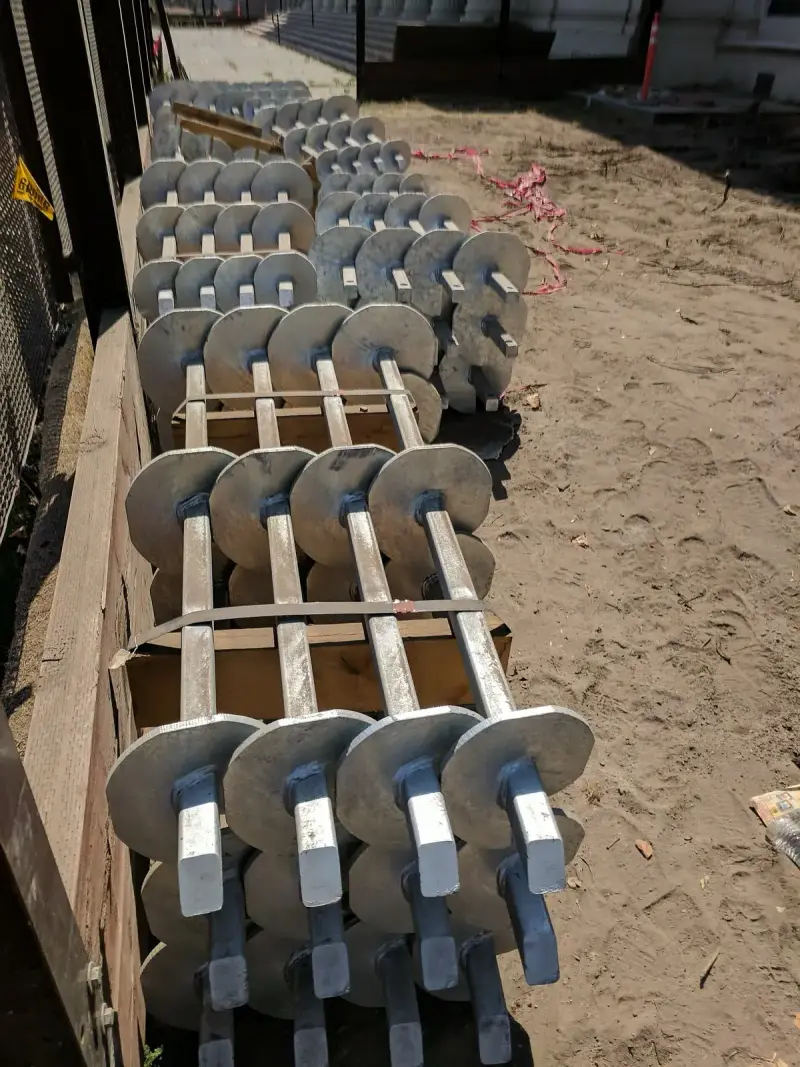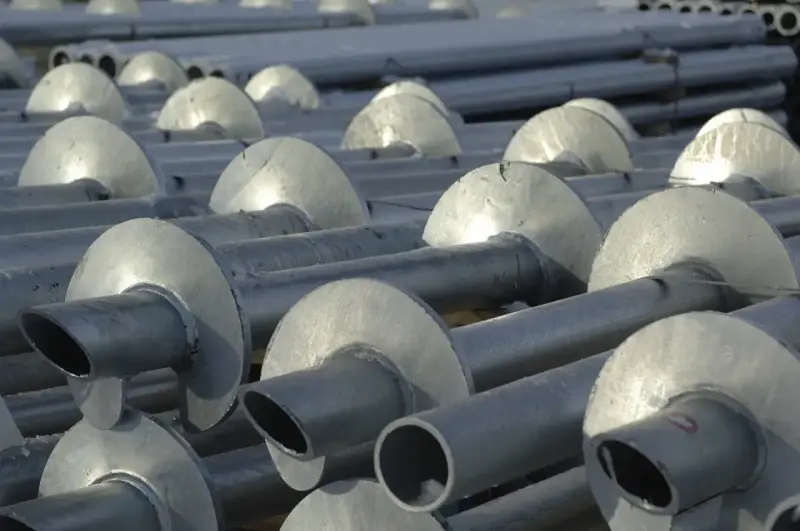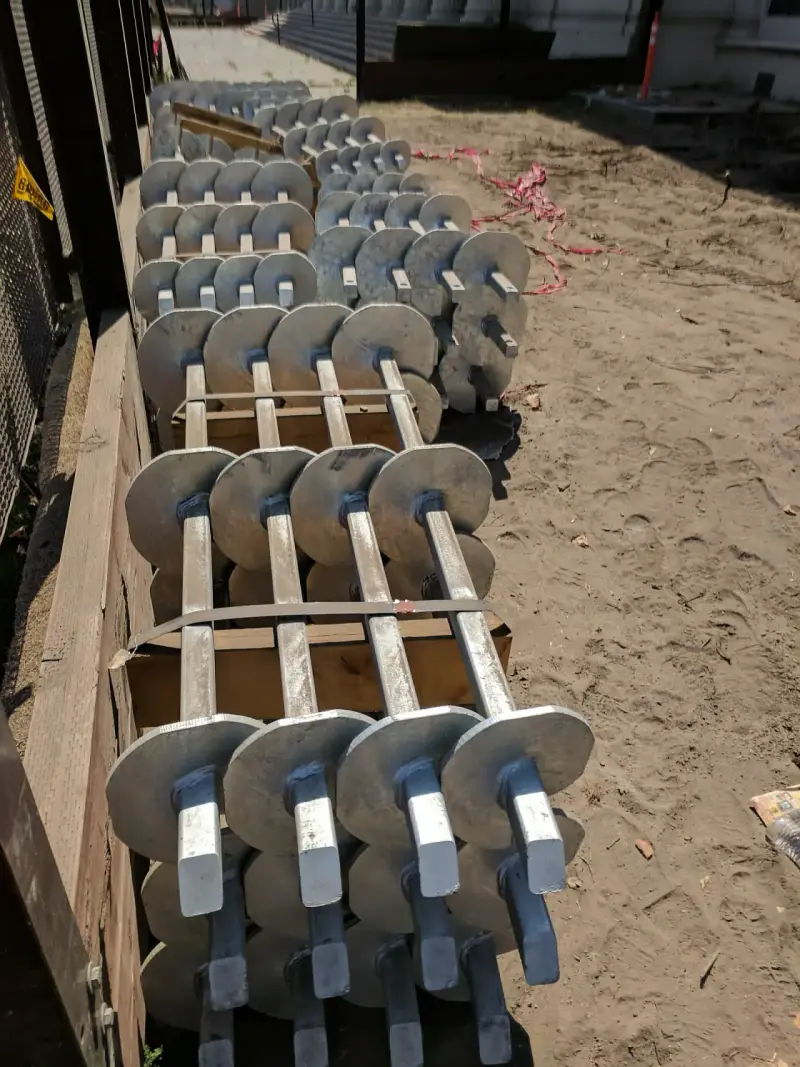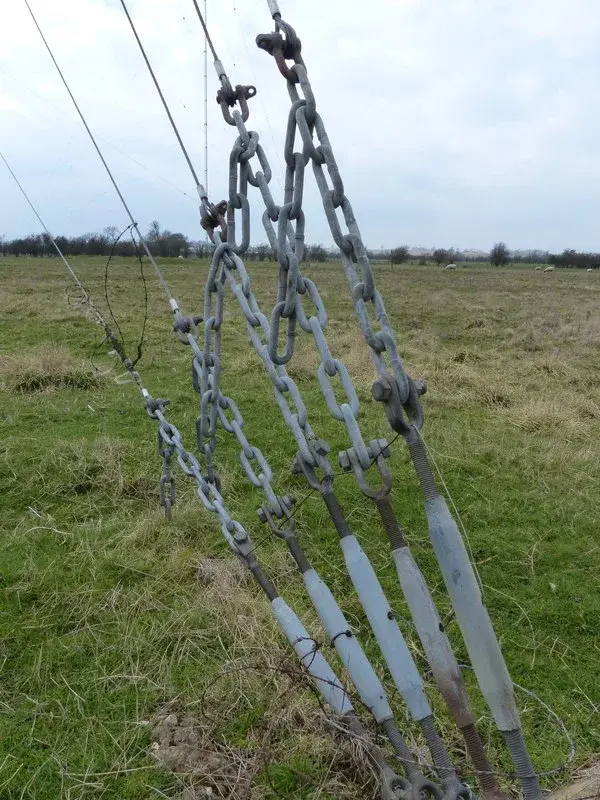
Helical anchors and helical piles are built the same way: a steel shaft with one or more helix plates, screwed into the ground. The difference is the job. A helical pile mainly pushes down on the soil (compression), like a footing. A helical anchor mainly resists being pulled out (tension), like a guy anchor holding a pole or a tie-down holding a canopy against wind. Many real projects need both directions, and that’s why the design, the depth and the testing differ even when the steel looks identical.
Where helical anchors came from
The product started as an anchor. Hubbell’s design manual traces the Chance helical line back to anchors for guying electric and telephone utility poles, later extended to foundations, retaining-wall tiebacks and soil nails (CHANCE Technical Design Manual). The torque-to-capacity method the industry still uses was originally derived for tension loads and later shown to work for compression too. That history is why the same catalog lists “anchors” and “piles”, and why the words get used interchangeably.
ICC-ES’s acceptance criteria for these systems, AC358, covers helical piles used to resist axial compression, axial tension or lateral loads, and treats them as one family (ICC-ES AC358).
Tension vs compression: what actually changes
| Helical pile (compression) | Helical anchor (tension) | |
|---|---|---|
| Load direction | Down, into the soil | Up or out, away from the soil |
| What resists it | Soil below each helix, plus shaft friction | Soil above each helix being lifted, plus shaft friction |
| Minimum depth concern | Below frost and active soil; deep enough to act as a deep foundation | Deep enough that the soil above the top helix can’t simply pop out as a cone |
| Example depth rule | Top helix at least 5 helix diameters deep for deep-foundation behavior (Hubbell/Chance) | Top helix at least 12 helix diameters below grade for tension in ESR-2794, unless an engineer justifies less |
| Connection | New-construction bracket cast into a cap or grade beam, or a post bracket | Tension-rated bracket, eye, or rod connection; AC358 has a tension-only bracket type |
| Field verification | Installation torque x Kt | Installation torque x Kt (AC358 uses the same Kt values for both) |
| Load test standard | ASTM D1143 (static axial compression) | ASTM D3689 (static axial tension) |
The 12D rule is the one that surprises people. For a 10-inch helix, 12 diameters is 10 feet to the top helix. ESR-2794 says that in tension the uppermost helix should be at least 12D below the ground surface, and that shallower installations need a registered design professional’s site-specific justification and fall outside the torque-correlation capacity in the report (ESR-2794, Sec. 4.2). In compression, the Hubbell/Chance manual recommends the top helix sit at least five diameters deep for deep-foundation behavior, and at least three diameters below the frost depth or active zone (CHANCE Technical Design Manual, Sec. 6). Same pile, different depth targets, depending on which way it’s loaded.
Where uplift comes from on Colorado projects
Tension isn’t only for guy wires. On the Front Range, uplift shows up in three common ways.
Wind. Light structures with big surface areas catch wind: carports, shade canopies, solar arrays, pavilions, sign structures, pole barns. Wind speeds vary a lot with location; Larimer County, for example, lists minimum basic wind speeds ranging from 115 to 225 mph across the county (Larimer County Structural Design Information). On a light roof, the uplift can exceed the dead load holding it down, so the foundation has to work in tension.
Swelling soil. Expansive clay grips a foundation element’s sides as it swells and pushes up. The Hubbell/Chance manual notes that the swell force on a shaft is proportional to the shaft’s surface area in contact with the soil, so the small shaft of a helical pile picks up much less uplift than a large driven pile or auger-cast pile. That uplift is still a tension load the helix below the active zone has to resist.
Overturning. Tall, narrow things like light poles and towers push down on one side and pull up on the other. Each foundation element sees both.
The post-frame industry’s foundation standard, ASAE EP486, makes the same distinction in its own terms: it notes that helical piers are primarily used to resist bearing and uplift forces (Bohnhoff, EP486 overview).
Which one does my project need?
| Project | Main load | What it usually needs |
|---|---|---|
| New home, addition, ADU on a grade beam | Compression, plus uplift from swelling soil | Helical piles with new-construction brackets; tension checked where clay is active |
| Deck, porch, walkway | Compression | Helical piles with post brackets |
| Carport, shade structure, pavilion | Wind uplift and compression | Piles designed for both; embedment checked for tension |
| Solar ground mount | Wind uplift, lateral, compression | Piles or anchors designed for combined loads |
| Guy wire for a pole or tower | Tension at an angle | Helical anchor installed in line with the guy |
| Light pole, sign, flagpole | Overturning (tension one side, compression the other) and lateral | Engineered pile group or single large pile |
| Retaining wall | Horizontal pull on the wall | Helical tiebacks (see our retaining wall post) |
| Pipeline in wet ground | Buoyancy (uplift) | Helical anchors holding the pipe down |
Retaining-wall tiebacks are their own topic; our retaining wall foundation article covers them. For solar, see why helical piles suit solar foundations.
Installing and testing anchors
Installation looks the same as for piles. The anchor is advanced at a steady rate while torque is measured; ESR-2794 requires torque-measuring equipment accurate to within 10 percent of the termination criterion and a minimum advance of 2.5 inches per revolution at the final reading (ESR-2794). Guy anchors are installed at the angle of the guy so the load runs straight down the shaft.
For larger projects or unusual soil, a tension load test per ASTM D3689 confirms capacity before production work, and can be used to refine the torque factor for that site. The Hubbell/Chance manual recommends that, for tension, the final installation torque be used in the correlation.
Questions to ask before you order anchors
- What’s the design tension, compression and lateral load at each location, and under which load combination?
- Does the design require a specific minimum depth to the top helix?
- What bracket or connection does the structure need, and is it rated for tension?
- Is there a load test requirement, and who witnesses it?
- Will the installer give you a torque and depth log for every anchor?
Need helical piles or anchors on the Front Range?
Site Safe Helical Piers installs helical piles and anchors for new construction across Denver and the Colorado Front Range, from homes and decks to canopies, solar and commercial work. Call 970-673-5615 or send us your loads and drawings, and see our services for the project types we cover.