The published cost of helical piles for a deck runs a few hundred dollars per pile, installed. HomeGuide puts new-deck piers at $300 to $500 each, and Helical Anchors Inc. lists $350 to $700 per pile for decks, porches and accessory structures. Your total is that per-pile price times the number of posts your deck framing needs, plus any extra depth, plus whatever the site and the permit add. Most homeowners can rough out the number before calling anyone, and this article shows how.
One thing first. Nobody can quote a firm price without knowing the deck layout and the ground, which is why most installer websites, ours included, ask for drawings and photos instead of posting a price list.
What published sources say a deck pile costs
| Source | What they publish | Notes |
|---|---|---|
| HomeGuide (Feb 2026) | $300 to $500 per pier installed for a new deck | National average for new decks |
| Helical Anchors Inc. (Aug 2026) | $350 to $700 per pile for decks, porches and accessory structures | A manufacturer, not an installer. Lists $500 to $1,200 per pile for additions and light commercial |
| Techno Metal Post | “A few hundred dollars” per deck pile; a deck of about 215 sq ft is “often a few thousand dollars” installed | Franchise network, no fixed prices online |
| HomeGuide | $20 to $25+ per foot beyond the quoted standard depth | Helical Anchors gives the same $20 to $25 per foot for extensions |
| HomeGuide | $45 to $50+ each for DIY helical posts from home stores | Check with your building department before using them on a permitted deck |
Those ranges are national. Colorado pricing sits somewhere inside or around them depending on the soil, the access and how busy installers are. Treat them as a sanity check on a quote, not a quote.
If you see figures in the thousands per pier, they’re for work under existing houses, which means hand digging and retrofit brackets. A new deck is open ground: the machine sets a pile and moves to the next one.
Step 1: Count the piles
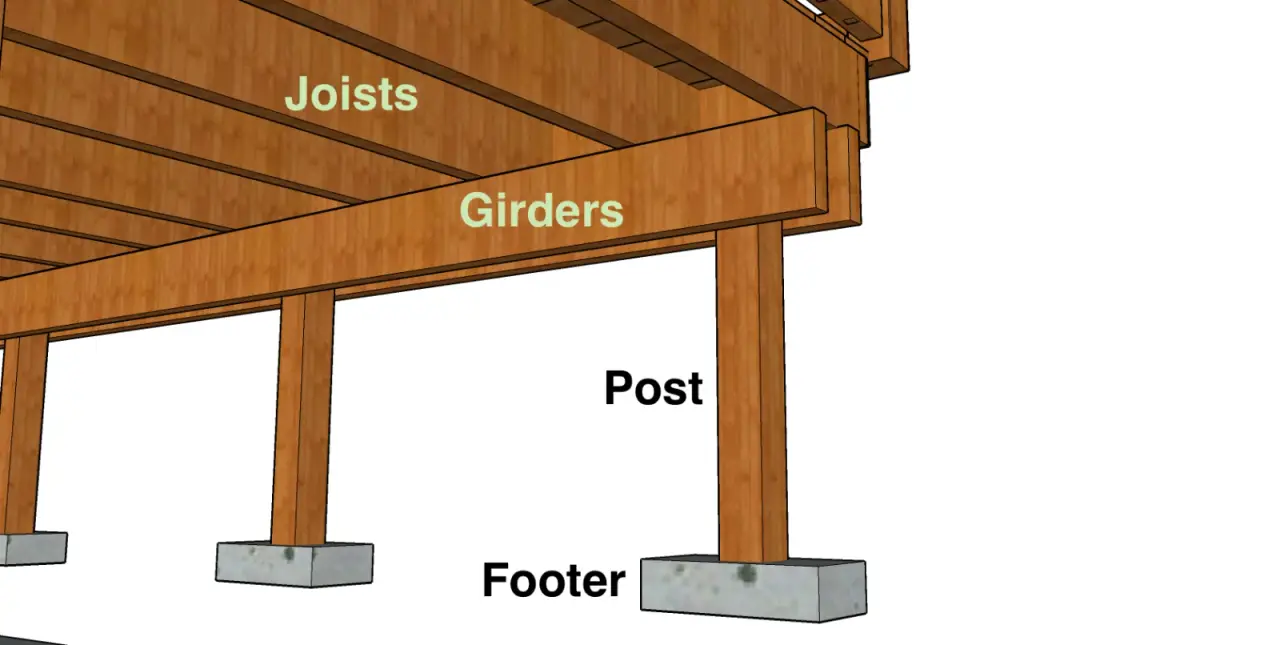
A deck pile goes under every post. So the pile count comes straight from the framing plan, and the framing plan comes from the joist and beam spans your deck builder picks.
Here’s the logic. Joists run from the house ledger out to a beam. The beam sits on posts. Each post carries the deck area that drains load to it, called its tributary area. The American Wood Council’s DCA 6 deck guide, which most inspectors know well, builds its footing tables this way, using 40 psf live load and 10 psf dead load. In Denver, check the snow number too: Table R301.2 of the city’s residential code lists a 43 psf ground snow load, and the deck footing table in R507.3.1 is based on whichever is higher, live load or ground snow.
A worked example: a 16 ft wide deck off the back of a house, 12 ft deep, with a ledger at the house and one beam at the outside edge. Put posts under the beam every 8 ft and you get three posts. The center post carries 8 ft of beam times half the joist span (6 ft), or 48 sq ft. At roughly 53 psf (43 snow plus 10 dead) that’s about 2,500 pounds on one pile. Each corner post carries half that. Those are small loads for a helical pile, which is why deck piles are usually the lightest models a manufacturer makes.
Step 2: Multiply, using real layouts
| Deck layout | Typical framing | Piles | At $300–$500 per pile (HomeGuide) | At $350–$700 per pile (Helical Anchors) |
|---|---|---|---|---|
| 12 x 16 ft, attached with ledger | One beam, posts about 8 ft apart | 3 | $900 – $1,500 | $1,050 – $2,100 |
| 14 x 20 ft, attached with ledger | One beam, posts about 6 ft 8 in apart | 4 | $1,200 – $2,000 | $1,400 – $2,800 |
| 12 x 16 ft, freestanding (no ledger) | Two beams, three posts each | 6 | $1,800 – $3,000 | $2,100 – $4,200 |
The freestanding deck costs more because it needs a second beam line where an attached deck would hang off the house. People often go freestanding to avoid a ledger on old siding or a stucco wall, and it’s a fine choice, but it roughly doubles the pile count.
Hot tubs change everything. A filled tub puts a concentrated load on a small area, so the piles under it are more numerous, larger, or both, and that part of the deck should be engineered. Don’t price a tub deck off a simple per-post count.
Step 3: Add the things that move the number
Depth. Per-pile prices assume a standard depth. If the pile hasn’t reached the torque it needs by then, the crew adds extensions, and both HomeGuide and Helical Anchors put that at roughly $20 to $25 per extra foot. Five extra feet on each of four piles is $400 to $500. Helical Anchors calls depth to bearing soil the largest single swing factor and the one nobody can price exactly before the first pile goes in. Ask whether your quote covers a stated depth and what happens past it.
Swelling clay. This is the Front Range part. The Colorado Geological Survey describes expansive soils that can swell 10 percent or more when wetted, with swelling pressures of up to 30,000 pounds per square foot. On those soils the goal is to put the helix plates below the zone that gets wet and dry seasonally, which can run deeper than the frost line. On a clay lot, plan for longer piles than you would in sand.
Mobilization. Getting a machine to your house costs about the same for four piles as for forty, as Helical Anchors points out. That’s why small decks carry a higher per-pile price than big ones, and why it can pay to do the deck, the pergola and the shed pad on the same visit.
Access. Open ground with a wide gate is the cheap version. A narrow side yard, a steep backyard, landscaping you want protected or a deck going in over an existing patio all mean smaller equipment and more hours.
Corrosion protection. Hot-dip galvanizing to ASTM A123 adds cost over bare steel. On a deck you expect to keep for decades, it’s money well spent.
Paperwork. Denver requires a zoning permit for an uncovered deck 12 inches or more off the ground and a building permit as well once it’s 30 inches or more off the ground. A permitted deck on helical piles usually needs the pile manufacturer’s evaluation report or an engineer’s letter in the permit set. Some installers include that, some charge for it. Ask.
What a concrete footing at Denver’s frost depth involves
Comparing a pile quote to “just pour some footings” only works if you price the footings honestly.
The Denver residential code (the 2024 IRC with local amendments) says decks must sit on “concrete footings or other approved structural systems” (R507.3). Footings must be at least 12 inches below undisturbed ground (R507.3.2). If the deck is attached to a frost-protected house, the footings must also be protected from frost, normally by going below the frost line (R507.3.3), and Denver’s frost line is 36 inches. The footing size comes from Table R507.3.1: at 50 psf and 1,500 psf soil, a post carrying 40 sq ft needs a 17 inch round footing and one carrying 60 sq ft needs 21 inches.
So each concrete footing on that 12 x 16 deck is a hole three feet deep or more, a footing inspection before the pour (DCA 6 notes the building official verifies bearing before concrete is placed), concrete, cure time, and spoil to haul away. On top of that, a 36 inch footing in swelling clay can still sit inside the soil that moves. That isn’t an argument that concrete is wrong. On a flat, open lot with good soil, concrete footings are often the cheaper answer, and a deck builder can give you that price to compare.
Where piles tend to win is the whole job rather than the line item: no digging, no spoils, no waiting on cure, framing the same day, and a torque reading on every pile that shows it reached firm soil.
How to read a deck pile quote
When a quote comes in, check that it tells you:
- How many piles, and where, matched to the deck framing plan.
- The pile model and helix size, and whether it’s galvanized.
- The depth included in the price and the cost per foot beyond it.
- The target installation torque, and whether you’ll get a log of final torque for every pile.
- Whether the permit letter or evaluation report is included.
- Who cuts the piles to height and sets the brackets your deck builder will attach to.
- Mobilization, access or restoration charges.
If two quotes differ by a lot, it’s usually because one assumes shorter piles or a lighter model. The cheaper steel is a small saving with a real downside if it doesn’t reach firm soil.
Get a number for your deck
Site Safe Helical Piers installs helical piles for new decks across Denver and the Colorado Front Range. We set the piles; your deck builder frames on top. Send your deck plan or a sketch with dimensions, a few photos of the yard and the access, and we’ll come back with a pile count and price. Call 970-673-5615 or use the contact form. For more background, see our posts on helical piles for decks and what goes into helical pile costs, or our services page.