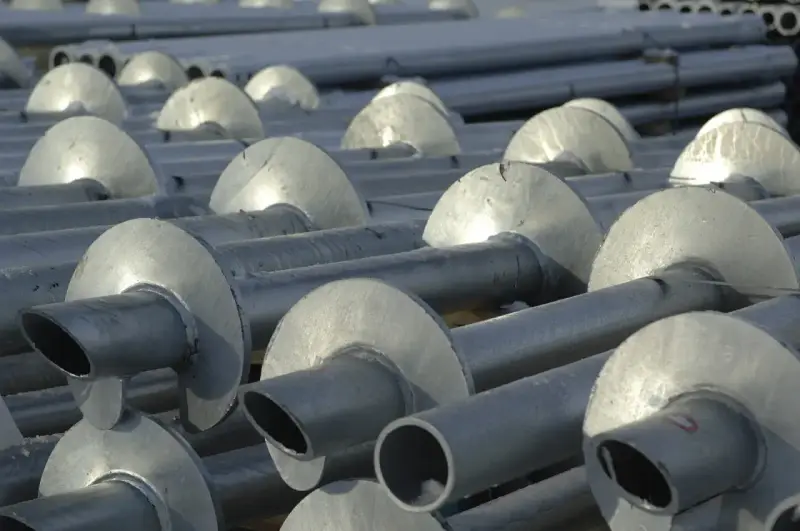
A certified helical pile installer usually means a crew that has been trained and authorized by a pile manufacturer. That’s worth having, but it isn’t what gets your foundation approved. What the building code and the product’s evaluation report care about is narrower and more checkable: a listed pile system, a design from a registered engineer, installation to a specified torque and depth with calibrated equipment, and a complete record for the inspector. Vet an installer on those four things and the certificate takes care of itself.
What “certified” means, and what it doesn’t
Most helical pile manufacturers run installer training programs and keep lists of approved or certified installers. The training covers their product, their brackets and their installation procedures. It’s a reasonable signal that a crew knows the system they’re putting in.
It doesn’t replace any of the following, which come from the code and from ICC-ES acceptance criteria AC358, the document manufacturers use to get helical piles evaluated for code compliance:
| Requirement | Where it comes from | What you should see |
|---|---|---|
| A code-evaluated pile system | ICC-ES evaluation report (ESR) issued under AC358 | The ESR number for the exact shaft, helix and bracket being installed |
| Design by a registered design professional | IBC 1810.4.11: piles installed to the embedment depth and torque criteria set by the registered design professional | Stamped drawings with pile locations, design load, minimum depth and target torque |
| Torque not exceeding the manufacturer’s limit | IBC 1810.4.11 | The max installation torque for the shaft, and a log that stays under it |
| Calibrated torque measurement | AC358: calibrated in-line indicator or calibrated torque motor via differential pressure, traceable to NIST | A current calibration certificate for the indicator or motor used on your job |
| Special inspection | IBC 1705.9: continuous special inspection during helical pile installation (check how your jurisdiction applies this to houses) | An inspector’s report or a log the engineer signs off |
| Complete install records | IBC 1705.9 and AC358 | Equipment used, pile and bracket configuration, tip elevation, final depth and final torque for every pile |
A crew can be manufacturer-certified and still show up without a calibration certificate. A crew can also be very good and have come up through a different manufacturer’s program. The table is the part that protects you.
Licensing and insurance in the Denver area
In Denver, building contractors are licensed by the city’s Community Planning and Development department in four classes under its policy ADMIN 120A: Class A (general), Class B (building), Class C (residential, one- and two-unit dwellings) and Class D (specialty). Surrounding cities and counties run their own licensing and registration, so ask the installer which jurisdictions they’re licensed or registered in and confirm it with the building department where your project is.
Ask for a certificate of insurance naming you or your general contractor, and check that general liability and workers’ compensation are both current. Pile installation puts heavy equipment in yards next to houses, gas lines and sprinkler systems. You want the coverage confirmed before the machine arrives.
Questions to ask on the bid call
These are the questions we’d want a client to ask us:
- Which pile system are you proposing, and what’s its ICC-ES evaluation report number?
- Who’s the engineer of record, and will you install to their target torque and minimum depth?
- What machine and drive head will you use, and does it fit our access?
- When was your torque indicator last calibrated? Can I have the certificate?
- Will I get a log for every pile with final depth and torque? Who signs it off?
- What happens if a pile doesn’t reach design torque at the expected depth? (Common answers: add extensions and go deeper, use a larger helix configuration, or call the engineer. All of those should involve the engineer.)
- What happens if a pile hits refusal above the minimum depth?
- Has the soils report been checked for corrosive conditions? AC358 puts soils with resistivity below 1,000 ohm-cm, pH below 5.5, sulfates above 1,000 ppm, high organic content, landfill or mine waste outside its normal scope, so those sites need special design.
- Who’s responsible for the pile caps and how do they tie into the concrete? Get the hand-off to the concrete contractor in writing.
- Can you show me a sample install log from a recent job, and photos of similar projects?
Red flags
| What you hear | Why it matters |
|---|---|
| “We go until it feels solid” | Capacity comes from measured torque, not feel |
| “We don’t need an engineer for this” | For a permitted structure, the code ties depth and torque to a design professional |
| No calibration certificate available | The torque log can’t be trusted, and so neither can the capacity |
| A price per pile with no depth assumption | Depth drives cost. A firm number without a depth allowance gets renegotiated in the field |
| Vague on which product they use | You need the ESR to match the drawings |
| No photos or references from similar new-construction work | Ask for jobs that match yours: decks, homes, additions, commercial or solar |
Where the installer fits in a new-construction job
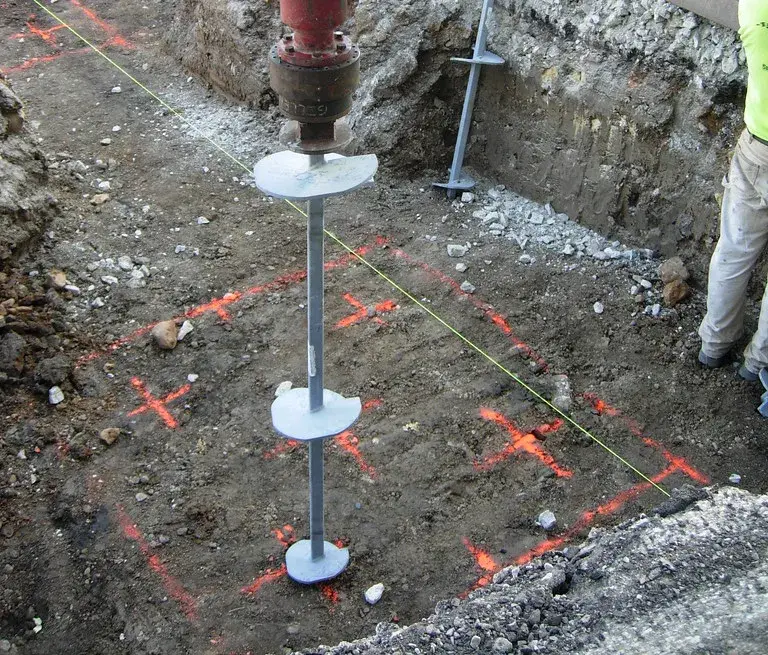
On new construction the installer is one link in a chain. The geotechnical engineer describes the soil. The structural engineer sets pile locations, loads, torque and depth. The installer puts the piles in and documents them. The special inspector or engineer verifies the installation. Then the concrete contractor forms and pours the caps and grade beams. A good installer makes the hand-offs easy: the log is complete, the cut-off elevations are right, and the engineer gets anything odd (shallow refusal, low torque) the same day.
The Deep Foundations Institute has a Helical Piles and Tiebacks committee that publishes design guidance and model specifications. If your engineer wants a reference for writing the spec, that’s a good place to start. Our post on helical pier installation shows what the process looks like on site.
Talk to Site Safe Helical Piers
Site Safe Helical Piers installs helical piles for new homes, additions, decks, commercial buildings and solar across Denver and Colorado’s Front Range. Ask us any of the questions above. Take a look at our services and gallery, then reach us through the contact page or at 970-673-5615.