Helical piles work in a lot of rocky soil, but not in solid rock. They can push past gravel and scattered cobbles, and they can often advance into the weathered top of shale or claystone bedrock. They can’t be screwed into hard, intact bedrock, and a dense layer of cobbles and boulders can stop a pile short or knock it off line. On the Front Range you meet all of these, sometimes on the same lot, so the useful question isn’t “can piles go in rocky soil” but “what’s in the boring logs, and what’s the plan if a pile stops early.”
What Front Range rocky ground actually is
“Rocky” covers three very different conditions around Denver.
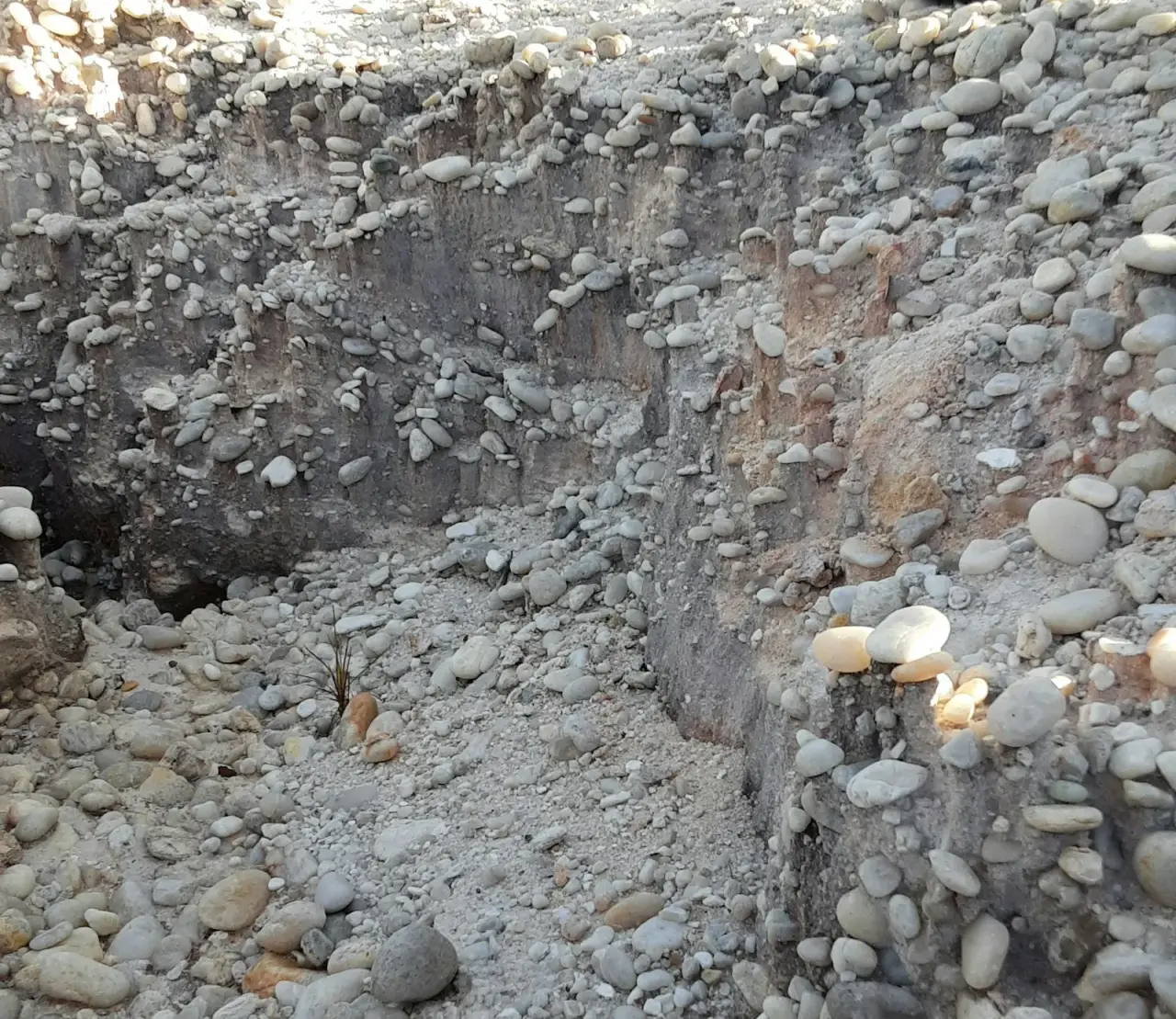
River gravel with cobbles. The alluvium laid down by streams coming out of the mountains is coarse. The USGS map of the Denver area says that in or near the mountains, and as far as 15 km east of them, 40 to 70 percent of the alluvium is gravel, and 10 to 30 percent of that gravel is typically cobbles and boulders (USGS MF-2347). That’s the ground along the South Platte and the creeks that drain the foothills, and in the older terrace gravels on the west side of the metro area.
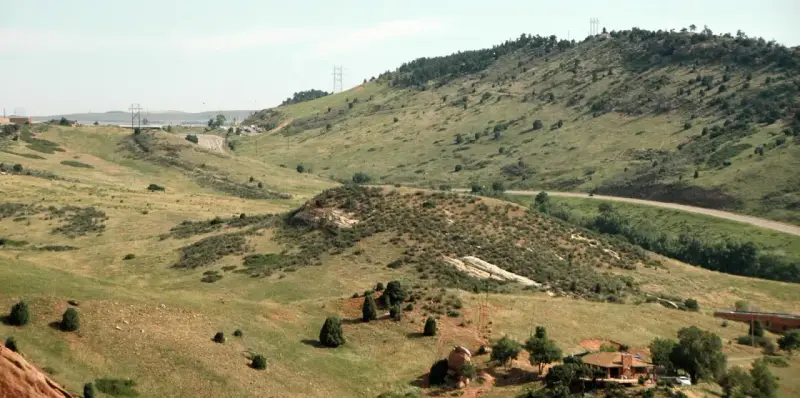
Weathered claystone and shale. Under much of the metro area, the soil sits on sedimentary bedrock: claystone, siltstone, sandstone and shale. The upper few feet are often weathered and soft enough to drill or screw into. Deeper down it gets harder.
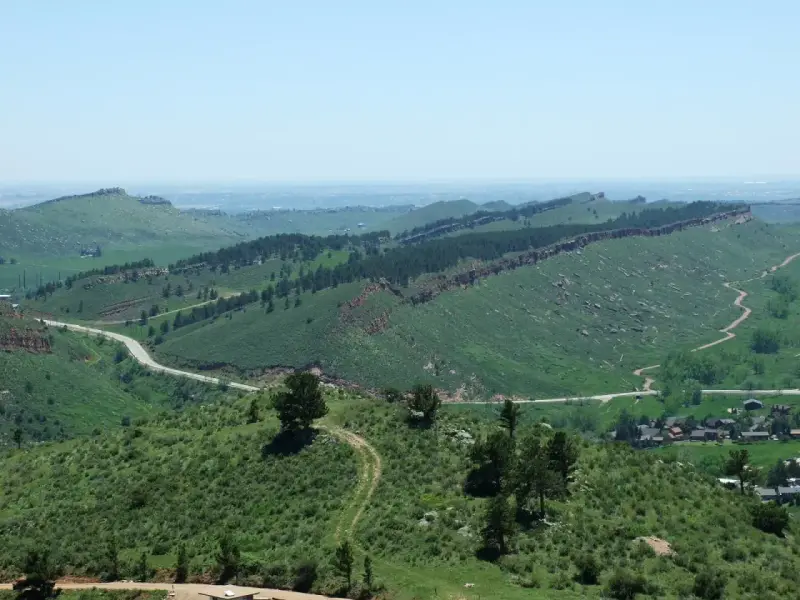
Steeply dipping bedrock and mountain talus. Along the foothills, bedrock layers tilt steeply, and the Colorado Geological Survey has documented heaving-bedrock damage in Pierre Shale and other Cretaceous formations along the Front Range piedmont (CGS SP-45). Up in the hills, slopes can be covered in broken rock and boulders.
Each one behaves differently with a helical pile.
Where helical piles work and where they don’t
The Hubbell/Chance design manual is direct about the limit: helical piles torqued into the ground can’t be installed into hard, competent bedrock. In weathered shale or sandstone at the top of the bedrock, the helix plates can often be advanced if the rock quality designation (RQD, a measure of how fractured the core is) is 0.30 or less (CHANCE Technical Design Manual, Sec. 2).
| Ground condition | How a helical pile behaves | Typical response |
|---|---|---|
| Sandy gravel, occasional cobbles | Usually advances; torque spikes when it hits a cobble | Standard helix; let the pile push or steer past the rock |
| Dense cobble/boulder layer | Pile may stop, deflect or spin without advancing | Seashell-cut helix, pre-drill, or move the pile per engineer |
| Weathered claystone/shale (soft, fractured) | Often advances and gives high torque; can be a good bearing layer | Standard or seashell helix; torque criteria set by engineer |
| Hard, intact bedrock | Won’t penetrate | Bear on top if the design allows, or use a different deep foundation |
| Fill with rubble or debris | Erratic torque; obstructions | Pre-drill or excavate the obstruction, then install |
Reading a refusal: torque that counts and torque that doesn’t
“Refusal” gets used loosely. In practice there are two kinds, and only one of them is good news.
The good kind: the pile reaches its required torque in competent soil or weathered rock while still advancing normally, at or below the required depth. That’s a finished pile.
The bad kind: the pile hits a cobble or a hard ledge and the torque gauge jumps, but the pile isn’t moving down. It’s spinning in place, or “augering”, chewing up the soil around the helix. That torque doesn’t mean capacity. ICC-ES ESR-2794 requires the pile to be advancing at least 2.5 inches per revolution at the time of the final torque reading, with installation speed under 25 rpm (ESR-2794, Sec. 4.2). The building code adds that installation torque can’t exceed the manufacturer’s rated maximum for the pile (IBC 1810.4.11). So an installer can’t just crank harder to get through a boulder; past the rating, the shaft or helix is at risk.
That’s why the installation log should show depth, torque and, ideally, penetration rate for each pile. If a pile “refused” at 4 feet on a site where the logs show 20 feet of cobbly alluvium, that’s a cobble, and the engineer should hear about it before anyone pours a cap.
Options when piles hit rock
The Hubbell/Chance manual lists three design changes for hard or mixed ground: cutting a “seashell” shape into the helix leading edge, pre-drilling before installation, and choosing a shaft that handles higher torque and torque spikes (CHANCE Technical Design Manual, Sec. 3). It notes that pre-drilling in weathered rock and cemented sand can let helix plates install under relatively high torque, generally above 10,000 ft-lb.
In practice, the options run roughly in this order:
- Back out and reinstall. A pile that deflects off a cobble can often be backed out a few feet and re-advanced, or steered past the rock. Techno Metal Post describes using a telescopic mast to “steer” a pile around rocks in its FAQ.
- Seashell-cut helix. A spiral-cut leading edge slices through debris, cobbles and fractured rock better than a straight edge. The manual recommends it specifically for those conditions.
- Pre-drill. Drill a pilot hole through the obstruction or into weathered rock, then install the pile. This adds a step and equipment but keeps a steel pile design.
- Relocate or add piles. If one location is blocked, the engineer may shift the pile and adjust the cap or grade beam, or add a pile.
- Change foundation type. If the logs show shallow, hard bedrock across the site, a drilled pier socketed into rock, or simply bearing on the rock, may suit better. That’s an engineering call, and an honest installer will say so.
What the soils report tells you before anyone bids
Most of the “rocky soil” surprises are in the boring logs if someone reads them. The Hubbell/Chance manual lists the purpose of the investigation for helical piles as locating the bearing stratum, weak zones, groundwater, corrosion potential, and “any barriers to installing the piles to the required depth such as fill, boulders or zones of cemented soils”. For a residential home it recommends one boring for every 100 to 150 lineal feet of foundation (CHANCE Technical Design Manual, Sec. 2).
When you get the report, look for:
- Words like “cobbles”, “boulders”, “auger refusal” or “practical refusal” on the logs, and at what depth.
- Depth to bedrock, and whether it’s described as weathered or hard.
- Blow counts (SPT N-values) climbing sharply, which signals dense layers.
- Whether the borings were stopped early. A boring that hit refusal at 8 feet doesn’t tell you what’s at 15.
- Fill. Old fill on infill lots can hide concrete, brick and rubble.
If the logs are thin or there aren’t any, a helical “probe” pile installed and logged for torque versus depth is another way the manual describes for gauging the ground before production work.
Building on rocky ground in the Denver area?
Site Safe Helical Piers installs helical piles for new construction across Denver and the Colorado Front Range, including sites with gravel, cobbles and weathered bedrock. Send us your soils report and plans through the contact page or call 970-673-5615, and we’ll tell you plainly whether piles are the right fit. For more on why the ground matters, see soil testing before building a new home and helical piers and Colorado soil, or browse our services.